
 AI Governance
 Data Centers
 Drones
 Climate
 Privacy
 2026 Maine Senate
 Bob Dylan
Who Sets the Rules for AI?
Coverage from IPI Global Observatory, Brookings, and others
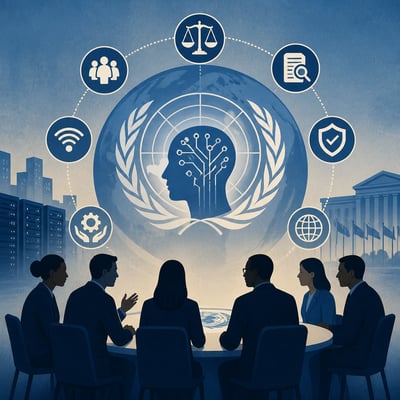
The United Nations is trying to build common rules for increasingly capable AI through shared testing methods, safety standards, incident reporting, child protections, environmental disclosures, and expanded access to technical capacity.
The effort remains largely consultative rather than binding, while the EU, United States, China, industry groups, and regional coalitions pursue different models for controlling frontier systems. The central tension is whether global rules can become practical and inclusive when compute, expertise, and decision-making power are concentrated in a small number of countries and companies.
The story gains practical governance detail, with proposals for independent testing, incident reporting, regulatory sandboxes, and human-rights baselines. The core assessment remains unchanged: the UN process is consultative, while enforcement authority and equitable access remain unresolved.
The story broadens from civilian and institutional AI governance toward military risks, especially lethal autonomous weapons, while highlighting African regional initiatives as another competing model. Proposed safeguards are framed more concretely, but remain nonbinding recommendations rather than implemented rules.
The story now presents the UN effort as an emerging governance architecture, not merely a dialogue forum, with scientific assessment and industry participation added but major measurement, enforcement, and capacity gaps unresolved.
The UN process is now framed less as an emerging path toward shared governance and more as a recurring coordination forum whose practical impact remains uncertain. New institutional continuity and evidence of weak national implementation sharpen concerns about whether dialogue can overcome fragmentation.
The story is more explicitly framed as a UN-led system-building effort, with the Geneva dialogue joined by the scientific panel’s preliminary assessment and a clearer emphasis on capacity-building and evaluation verification. The core tension remains unchanged: technical coordination is advancing faster than binding global authority or broad implementation.
The story is now framed less as a general UN-centered governance effort and more as an active multilateral coordination process centered on shared evidence, technical standards, and interoperability. The main substantive shift is the clearer emphasis on implementation gaps and institutional fragmentation, especially around enforcement, compute concentration, and uneven national oversight capacity.
The story has shifted from a general push for UN-led AI governance to a more specific assessment that global coordination is now taking shape around the July 2026 Geneva dialogue, but actual governance capacity is still trailing AI deployment. New evidence highlights weak enforceable safeguards, especially in the Global South, and persistent disagreements over binding rules, verification, and compute access.
- July 2026 Geneva dialogue became the focal UN governance event.
- Preliminary UN assessment found evidence and evaluation methods lag AI capabilities.
- GIRAI reported especially weak legally enforceable safeguards in the Global South.
- Follow-up planning extends into 2027 and 2027-2028 review.
- Sectoral gaps in health and public administration are newly highlighted.
The United Nations is expanding its role in international AI policy through the Independent International Scientific Panel on AI and a standing Global Dialogue on AI Governance. The emerging agenda combines human rights, transparency, capacity-building, digital inclusion, and open AI systems with calls for stronger oversight of frontier model development, evaluation, incident reporting, and corporate accountability. Progress remains constrained by concentrated control of compute and AI infrastructure, competing national approaches, and disagreement over whether global commitments should be binding or voluntary.