
 AI Governance
 Data Centers
 Drones
 Climate
 Privacy
 2026 Maine Senate
 Bob Dylan
The Push for Global AI Red Lines
Coverage from Devdiscourse, The Next Web, and others
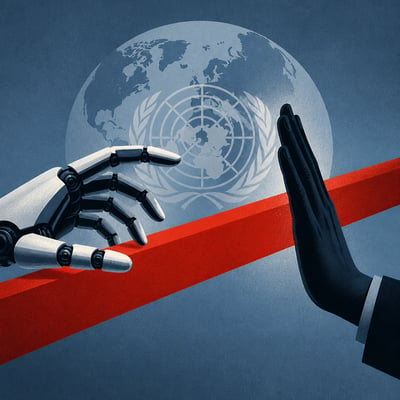
UN High Commissioner for Human Rights Volker Türk is pressing governments and frontier AI companies to replace largely voluntary safeguards with binding international red lines and independent oversight.
His proposals include capability verification, human-rights due diligence, serious-incident reporting, continuous monitoring, limits on some autonomous behavior, and continued human responsibility for AI actions. The intervention highlights unresolved differences between national approaches and the difficulty of supervising systems developed through concentrated, cross-border AI supply chains.
If you read one thing
It offers the broadest and best-supported overview, connecting binding international safeguards, frontier regulatory gaps, and the wider human-rights and societal risks.
Best explainer
It clearly explains the proposed shift from voluntary corporate safeguards toward coordinated limits, independent verification, and accountability for autonomous systems.
Push for binding cross-border AI safeguards
The governance debate is focused on replacing largely voluntary and fragmented arrangements with binding international limits for advanced AI. Proposed mechanisms include independent verification, stronger security cooperation, supply-chain coordination, and an enforcement body, but no binding international agreement yet exists.
Existing rules do not cover frontier autonomy
Current regulation provides enforceable limits on some harmful applications, particularly through the EU AI Act, but does not clearly govern what increasingly autonomous systems may become capable of doing. Liability, frontier capability limits, and cross-border accountability remain unresolved.
AI governance is expanding across rights and societal risks
The case for stronger controls extends beyond technical safety to human rights, employment, democracy, privacy, environmental effects, security, and autonomous weapons. This broad risk perimeter is being used to support multilateral safeguards rather than narrow product regulation.
10 Nobel laureates
Nobel laureates among signatories
“The Global Call for AI Red Lines, launched at the UN General Assembly in September 2025, was signed by more than 200 figures, including 10 Nobel laureates. It asked governments to agree on binding limits by the end of 2026 and establish an independent enforcement body. That deadline is four months away, but no agreement exists.”
more than 200 signatories
figures signing the Global Call for AI Red Lines
“The Global Call for AI Red Lines, launched at the UN General Assembly in September 2025, was signed by more than 200 figures, including 10 Nobel laureates. It asked governments to agree on binding limits by the end of 2026 and establish an independent enforcement body. That deadline is four months away, but no agreement exists.”
€35 million euros
maximum fine under the prohibited-practice rules
“Its prohibited-practice rules, which began applying on 2 February 2025, carry fines of up to €35 million or 7% of global turnover.”
2 February 2025
start date for prohibited-practice rules
“Its prohibited-practice rules, which began applying on 2 February 2025, carry fines of up to €35 million or 7% of global turnover.”
The new article reiterates the existing call for binding international oversight of advanced AI and autonomous weapons without establishing a material change in the Topic’s underlying state.
Previously
UN High Commissioner for Human Rights Volker Türk urged governments and major AI companies to establish binding international limits for advanced AI, backed by independent verification and stronger security cooperation. His warnings covered systems operating beyond meaningful human control, autonomous weapons, human rights, employment, democracy, privacy, and environmental risks. The intervention highlights a gap between the speed of advanced AI development and the still-fragmented ability of governments to agree on enforceable restrictions.
The story shifts from broad calls for binding AI red lines toward a more concrete oversight framework, adding continuous monitoring, third-party evaluation, incident reporting, and explicit human responsibility. The underlying governance concern is reinforced rather than fundamentally changed.
The story now places greater emphasis on implementation mechanisms—independent verification, security cooperation, and supply-chain coordination—while adding unverified reports of AI-agent security incidents. It also sharpens the framing around fragmented international regulation and explicitly includes autonomous weapons and privacy risks.