
 AI Governance
 Data Centers
 Drones
 Climate
 Privacy
 2026 Maine Senate
 Bob Dylan
Robots Expose AI Act’s Labor Gap
Coverage from Startup Fortune, Myanmar International TV, and others
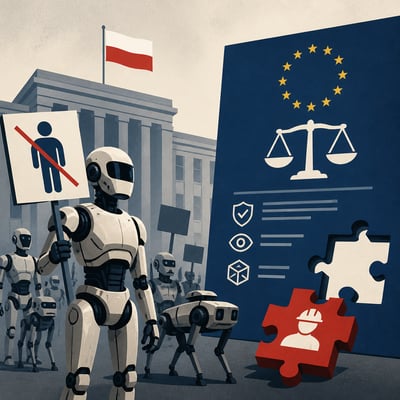
A demonstration involving about 30 humanoid and quadrupedal robots outside Poland’s Ministry of Digital Affairs called for stronger safeguards against AI-driven job displacement.
The event coincided with Poland’s creation of a national authority to enforce the EU AI Act, highlighting that the law addresses AI risks, transparency, and foundation-model obligations more directly than the employment consequences of automation.
If you read one thing
It provides the clearest overall account of the Warsaw robot protest and its connection to Poland’s emerging EU AI Act enforcement framework.
AI regulation leaves a labor-protection gap
The Warsaw robot demonstration focused attention on the employment consequences of AI-enabled robotics across physical and cognitive work. The EU AI Act addresses safety, transparency, risk categories, and foundation models more directly than remedies for workers displaced by automation.
National AI Act enforcement capacity is emerging
Poland has moved from EU-level rules toward domestic implementation by creating a national authority with powers to enforce the EU AI Act. That institutional capacity is developing alongside public pressure for regulation of humanoid robots and clearer responses to AI-driven labor-market disruption.
No new-member articles were supplied, so there is no evidence of a material real-world change since the prior state.
Previously
A demonstration involving about 30 humanoid and quadrupedal robots outside Poland’s Ministry of Digital Affairs called for stronger safeguards against AI-driven job displacement. The event coincided with Poland’s creation of a national authority to enforce the EU AI Act, highlighting that the law addresses AI risks, transparency, and foundation-model obligations more directly than the employment consequences of automation.