
 AI Governance
 Data Centers
 Drones
 Climate
 Privacy
 2026 Maine Senate
 Bob Dylan
Microsoft Expands Agentic AI Governance
Coverage from Mexico Business, IT Brief New Zealand, and others
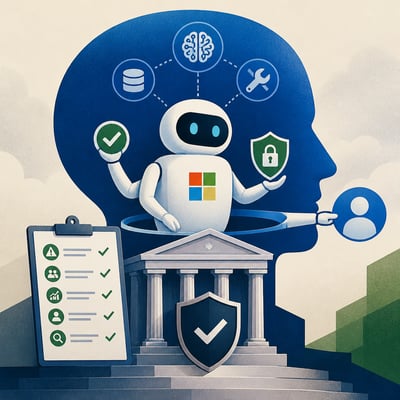
Microsoft's 2026 responsible AI program is moving toward lifecycle governance for agentic systems, combining deployment reviews, permissions, runtime monitoring, red teaming, external assurance, and post-launch controls.
If you read one thing
It provides the clearest broad account of Microsoft’s shift to continuous, system-wide governance for agentic AI.
Latest development
It materially updates the topic with quantified reporting on Microsoft’s reviews and operational agent controls.
The evidence
It supplies the primary-source account of deployment-specific responsibilities and lifecycle safeguards in the revised standard.
Governance is shifting to deployment and system-wide responsibility
Microsoft’s revised framework extends oversight beyond model development to deployment, real-world use, and interconnected systems. It separates developer and deployer responsibilities and adds deployment-specific assessment, mitigation, user disclosure, and post-launch monitoring for third-party AI applications.
Agent governance is becoming continuous and action-focused
Microsoft treats agents that retain memory, use tools, access data, and act for users as requiring lifecycle oversight rather than one-time pre-release review. The reported control set combines threat modeling, permissions and identities, approval gates, phased deployment, prompt-injection defenses, runtime monitoring, repeatable testing, and incident review.
AI assurance is being formalized through standards and external testing
Microsoft is pairing governance requirements with formal assurance mechanisms, including ISO 42001 certification, university-based red teaming, expanded benchmarks, and tools that convert adversarial findings into repeatable evaluations. The reported assurance evidence is substantial but remains primarily company-disclosed.
nearly 2,500 reviews
generative AI product and feature reviews
“Microsoft’s governance process follows the NIST AI Risk Management Framework’s Govern, Map, Measure, and Manage functions, with pre-release reviews and post-release monitoring. Between July 2025 and June 2026, the company supported more than 450 Sensitive Use reviews and nearly 2,500 generative AI product and feature reviews. More than 30% of Sensitive Use cases involved agentic AI.”
More than 30% percent
Sensitive Use cases involving agentic AI
“Microsoft’s governance process follows the NIST AI Risk Management Framework’s Govern, Map, Measure, and Manage functions, with pre-release reviews and post-release monitoring. Between July 2025 and June 2026, the company supported more than 450 Sensitive Use reviews and nearly 2,500 generative AI product and feature reviews. More than 30% of Sensitive Use cases involved agentic AI.”
more than 450 reviews
Sensitive Use reviews
“Microsoft’s governance process follows the NIST AI Risk Management Framework’s Govern, Map, Measure, and Manage functions, with pre-release reviews and post-release monitoring. Between July 2025 and June 2026, the company supported more than 450 Sensitive Use reviews and nearly 2,500 generative AI product and feature reviews. More than 30% of Sensitive Use cases involved agentic AI.”
20 cards
application and platform cards published
“As regulation develops across jurisdictions, Microsoft is expanding transparency documentation and external collaboration. It published data summaries and model cards for models including MAI-Image-1 and Phi-4-Reasoning, and since January 2026 has published 20 application and platform cards. The company contributed to the OECD-led Hiroshima AI Process Reporting Framework 2.0 and joined the Appia Foundation as a founding member to support AI assurance across supply chains and deployment sectors.”
more than 3,000 engineers
engineers trained in agentic AI threat modeling
“Agentic systems introduce risks involving tool misuse, permission escalation, memory poisoning, and cross-agent interference. Microsoft trained more than 3,000 engineers in agentic AI threat modeling and introduced ASSERT, an open-source framework for translating written agent policies into repeatable evaluations.”
Microsoft extends agent oversight into quantified reviews and external assurance
Microsoft’s governance program is now described not only as a redesigned framework but as an operating process with reported scale: nearly 2,500 generative-AI reviews, more than 450 Sensitive Use reviews, and over 30% of Sensitive Use cases involving agents. The company also reports broader external assurance through an 18-university red-team alliance and ISO certification, extending oversight beyond internal controls.
Previously
Microsoft’s 2026 Responsible AI Transparency Report describes a redesigned standard for models, platform services, applications, and agentic systems that can retain memory, use tools, access data, and act on users’ behalf. The changes separate developer and deployer responsibilities and add controls for threat modeling, third-party application assessment, phased releases, user approvals, monitoring, prompt-injection defenses, and incident review. The approach shows Microsoft adapting internal oversight to systems with greater autonomy, while the reported controls and outcomes remain primarily based on Microsoft’s own disclosures.
The story shifts from describing Microsoft’s redesigned controls to documenting a more operational lifecycle-governance program, with quantified reviews and broader post-launch oversight.