
 AI Governance
 Data Centers
 Drones
 Climate
 Privacy
 2026 Maine Senate
 Bob Dylan
From AI Principles to Enforceable Controls
Coverage from Bloomberg Law, Virtualization Review, and others
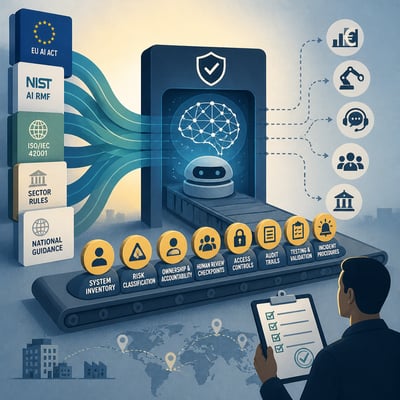
Organizations are moving AI governance beyond principles and policy statements toward system inventories, risk classification, named accountability, human review, continuous monitoring, and audit-ready evidence.
The EU AI Act is a major reference point, influencing companies beyond Europe alongside frameworks such as NIST AI RMF and ISO/IEC 42001. The practical challenge is extending oversight to informal, embedded, third-party, and increasingly agentic AI systems whose decisions or actions may affect hiring, credit, customer services, software, and other regulated activities.
The story is largely confirmed, with a modest broadening toward vendor governance, third-party models and APIs, and software-development workflows. The current version also more explicitly distinguishes tested, enforceable controls from disclosure alone.
The update largely confirms the existing shift toward operational AI controls, while sharpening that automated governance cannot replace empowered human judgment in high-impact decisions.
The story is more explicitly reframed around runtime governance of AI agents, shifting accountability from model oversight toward controlling identities, permissions, tool calls, and downstream actions across fragmented regulatory regimes.
The story shifts from building AI governance structures to proving that controls work in practice. The central unresolved issue is now execution assurance, especially for shadow, embedded, and agentic AI.
The story shifts from designing governance frameworks to extending operational controls across overlooked AI use, technical workflows, and autonomous systems. Governance is increasingly framed as an operational and liability requirement, with fragmented implementation across jurisdictions complicating compliance.
Organizations are formalizing AI governance as AI systems and agents move into finance, engineering, customer operations, public-facing decisions, and other consequential workflows. The EU AI Act, NIST AI RMF, ISO/IEC 42001, sector rules, and national guidance are increasingly being translated into system inventories, risk classifications, named ownership, human-review checkpoints, access controls, audit trails, testing, and incident procedures. The main implementation challenge is making responsibility and evidence traceable when automated systems generate outputs, invoke tools, or take actions across organizational and supplier boundaries.