
 AI Governance
 Data Centers
 Drones
 Climate
 Privacy
 2026 Maine Senate
 Bob Dylan
Bipartisan Push for Federal AI Safeguards
Coverage from Live Index, NBC News, and others
U.
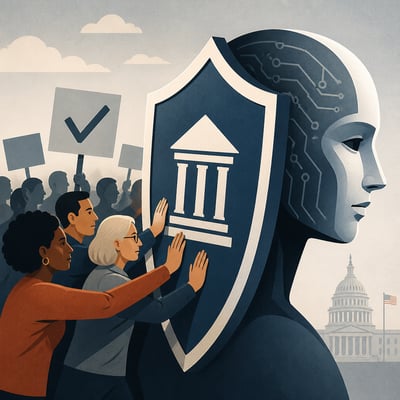
S. polling across multiple surveys shows broad bipartisan support for federal AI oversight, mandatory safety testing, and safeguards for systems used in critical decisions. The findings contrast with the administration’s largely voluntary or lighter-touch approach and are fueling proposals for a dedicated regulator, government-designed evaluations, and stronger obligations for advanced model developers. The central policy tension is how to impose credible safety and accountability requirements without slowing innovation or weakening U.S. competitiveness.
The story is less about abstract public support and more explicitly about a live policy contest between a voluntary White House approach and proposals for binding federal AI oversight. The framing also broadens to include Congress, named polling groups, and specific institutional options like an independent safety body under SEC oversight.
The story has shifted from broad public pressure for tougher AI rules to more concrete policy pathways, including mandatory safety evaluations and the possibility of a dedicated federal watchdog. The new version also adds a sharper regulatory debate over how to oversee general-purpose models and downstream deployers while balancing innovation and China-related competition.
- Mandatory AI safety evaluations before deployment now feature prominently.
- A Finra-style watchdog under SEC oversight is being proposed.
- Regulation may cover both model developers and downstream deployers.
- Academic modeling warns application-only rules may reduce developer safety investment.
- Scope, funding, enforcement, and regulator location remain unresolved.
The main change is a reframing toward stronger, more explicit public demand for federal AI safeguards, with tech companies now singled out alongside government as major responsible actors. The current version also softens the earlier focus on state-versus-federal responsibility and replaces it with broader emphasis on shared accountability and international coordination splits.
This topic centers on polling that shows strong U.S. support for urgent AI regulation, with most respondents prioritizing public protection over faster innovation. The material also reflects broad skepticism about AI judgment, especially for ethical decisions, alongside debate over whether responsibility should sit with federal, state, or industry actors. It matters because public attitudes are increasingly aligning with calls for stronger oversight even as federal policy under the Trump administration remains more permissive overall.