
 AI Governance
 Data Centers
 Drones
 Climate
 Privacy
 2026 Maine Senate
 Bob Dylan

UN And Global AI Governance
Coverage from World Economic Forum, Nature, and others
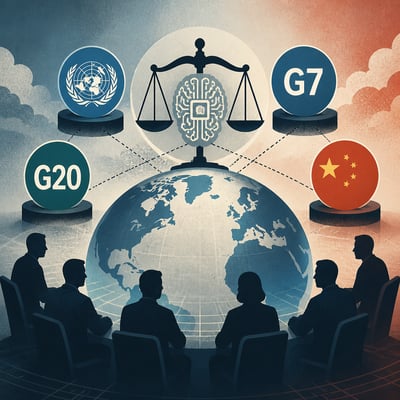
UN-led AI governance efforts are gaining momentum as governments, experts, and major AI companies grapple with fragmented national rules, cross-border accountability gaps, and the need for shared standards.
Geneva-based UN processes, including the Global Dialogue on AI Governance and military AI exchanges, are the main near-term coordination vehicles, while broader proposals push for enforceable, risk-based international rules.
The story has sharpened from broad international coordination into a more concrete UN-centered process, with Geneva now the main coordination hub and military AI becoming a distinct parallel track. It also newly foregrounds specific companies and technical issues, especially the limits of internal safety tools and the need for interoperable external oversight.
- Global Dialogue on AI Governance in Geneva is now the main near-term coordination vehicle.
- UN-supported military AI exchanges have become a distinct governance track.
- OpenAI and Google DeepMind are newly cited alongside Anthropic.
- Low-resource languages are newly identified as a safety and governance risk.
- Proposals now emphasize enforceable, risk-based international rules.
The story is reframed more explicitly around access and distributional power: who controls compute, infrastructure, and expertise is now central to AI governance, alongside traditional coordination and oversight questions. It also broadens attention to the Global South and EU-China sovereignty/competitiveness dynamics.
The story has shifted from broad debate over AI governance frameworks to a more concrete picture of implementation: Geneva-led UN processes, risk-based regulation, and enforcement capacity are now central. Governance is increasingly framed around practical interoperability, frontier-model controls, and compute/infrastructure concentration rather than just principles.
- UN-led processes in Geneva are the most visible organizing venue.
- Risk-based regulation is spreading across jurisdictions.
- Compute, data, and infrastructure concentration is now a governance issue.
- Military AI discussions now center on TEVV and deployment compliance.
- The signal is structural and ongoing, not short-term.
Global institutions and major powers are converging on the question of how to govern advanced AI across borders, with the UN, G7, and G20-style coalitions all presented as possible accountability frameworks. The material centers on a shared concern that internal company safeguards are not enough and that global coordination is needed to manage risks such as frontier model access, cyber misuse, military deployment, and systemic harm. A second pattern is fragmentation: multiple venues and competing governance models are emerging at once, including UN processes, U.S.-led coalition ideas, and China’s proposed global cooperation forum.