
 AI Governance
 Data Centers
 Drones
 Climate
 Privacy
 2026 Maine Senate
 Bob Dylan
Retail Facial Recognition Faces Pushback
Coverage from Kansas.com, Bradenton, and others
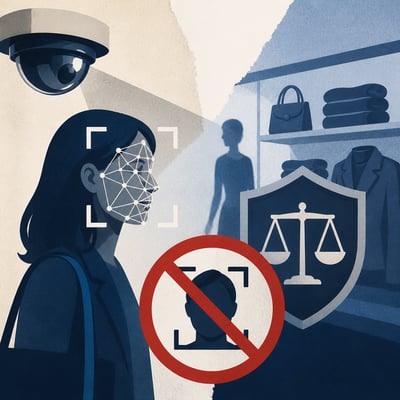
Facial recognition is being deployed or considered in grocery stores, entertainment venues, and other public-facing settings for loss prevention, security, customer identification, and potentially marketing or pricing.
The practice is drawing scrutiny over scanning people who are not suspected of wrongdoing, unclear data retention and sharing, error and bias, and the use of biometric profiles as persistent identifiers. Lawmakers in New York, Connecticut, and elsewhere are pursuing restrictions, while disputes involving Madison Square Garden and a Clearview AI criminal case are testing disclosure and accountability requirements.
The story now gives greater prominence to Madison Square Garden, adding disputes over attendee databases, alleged targeting, and a related data breach. This makes data exposure and venue accountability more concrete, while the broader deployment and legislative picture remains largely unchanged.
The story has broadened from targeted theft prevention and investigative use to include customer profiling and marketing, while regulatory restrictions and court-ordered disclosure efforts have intensified.
- Erie County enacted a broad private-sector biometric collection ban with daily fines.
- Connecticut lawmakers proposed a retail-focused facial-recognition prohibition.
- A Washington, D.C., judge ordered prosecutors to disclose Clearview AI's use in an arrest.
- Retailers are marketing facial recognition for returning-customer identification and personalized promotions.
- Wegmans notices describe facial, eye, and voice-data collection without specifying retention or sharing practices.
The main change is a stronger emphasis on formal disclosure and oversight: New Jersey’s court order now specifically requires prosecutors to reveal how facial recognition was used, and New York lawmakers added a local disclosure/data-profit restriction in Onondaga County. The story also broadens slightly from retail use to venue access disputes at Madison Square Garden.
The story adds a sharper enforcement and implementation angle: retail facial recognition is moving forward in more places, while courts and lawmakers are actively tightening disclosure and use limits. The biggest new wrinkle is the combination of expansion, a reported false match, and a court order demanding more transparency about criminal-use software.
- Grocery Outlet is deploying SAFR in some Bay Area stores.
- Sainsbury’s plans expansion to as many as 200 UK locations.
- Reported Sainsbury’s false match led to customer confrontation or removal.
- New Jersey Supreme Court ordered facial-recognition software disclosure in a criminal case.
- Syracuse lawmakers are considering biometric use and monetization restrictions.
The story has broadened from a New Jersey/New York policy dispute into a wider, more concrete pattern of actual facial-recognition deployment in retail and venues across multiple jurisdictions. At the same time, regulation and court disclosure rules are becoming more operational, with clearer limits, notices, and penalties emerging alongside the technology rollouts.
- Retail and venue deployments are now described as the most active development.
- The story expands to California and the United Kingdom.
- Grocery Outlet and Sainsbury's are new deployment examples.
- Facewatch and SAFR appear as named biometric vendors.
- Madison Square Garden adds venue-surveillance litigation to the story.
The story is more specifically framed around transparency: New Jersey’s court ruling clarifies the boundary between required facial-recognition discovery and protected trade secrets, while New York City debates increasingly emphasize retail profiling and surveillance pricing.
The story now extends beyond retail privacy restrictions into criminal justice, as New Jersey courts require prosecutors to disclose key facial-recognition evidence and reliability information.
The story has broadened from a general state-and-local retail biometrics crackdown to a more concrete New York county/city push with specific compliance mechanics and penalties. It also adds clearer exemptions and sharper scrutiny of Wegmans’ data practices, making the regulatory direction more operationalized.
- Syracuse Common Council joins the restriction push.
- Erie County is described as the first New York county to enact a retail biometric ban.
- Compliance windows and civil penalties are now part of the regulatory model.
- Proposals now mention exemptions for financial institutions and law enforcement duties.
- Wegmans scrutiny now includes possible third-party access.
Retail facial recognition is drawing fast-moving state and local regulation in the U.S. and continued debate in the U.K., with lawmakers focusing on notice, retention, data sharing, and bans on biometric collection. The strongest signal is a shift from abstract privacy concern to concrete limits on how stores collect and use face, voice, and iris data.