
 AI Governance
 Data Centers
 Drones
 Climate
 Privacy
 2026 Maine Senate
 Bob Dylan
ICE Expands Domestic Surveillance Tools
Coverage from CNN, WSJ, and others
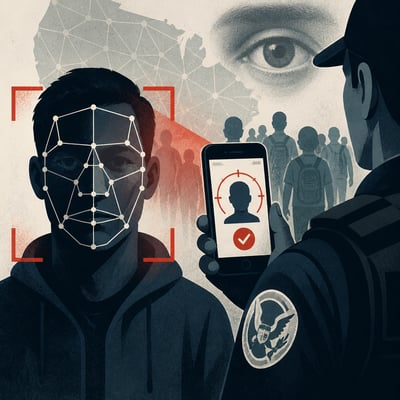
ICE and other Department of Homeland Security components are reported to be expanding their use of facial recognition, license-plate readers, geofencing, phone forensics, social-media monitoring and data-broker information to identify and track people in the United States.
Reporting also describes plans to extend some capabilities to local police and to combine immigration records with government, commercial and biometric data. The developments matter because they increase the scale and reach of immigration surveillance while prompting disputes over warrants, data retention, accuracy, secondary use and oversight.
The story is largely reaffirmed, but the current version shifts from describing broad surveillance expansion to emphasizing more concrete operational details: contactless fingerprint collection, 15-year retention of biometric data, and a more explicit push to extend facial-recognition access to local police. The framing also slightly broadens to include geofencing and commercial data-broker information as part of the linked surveillance stack.
The story has sharpened from a broad account of immigration surveillance into a more specific claim that ICE and DHS are expanding access to facial recognition and integrated data systems, including to local police. The new version also more directly emphasizes spillover onto citizens, protesters, and nearby communities, and the unresolved legality and oversight of these capabilities.
- Reported DHS plan would let about 1,300 local police agencies use ICE facial recognition.
- Photographs, including U.S. citizens’, are reportedly retained for 15 years.
- Palantir ImmigrationOS is newly named alongside ELITE.
- Access to IRS, Social Security, and health-related records is newly described.
- Surveillance is now explicitly tied to citizens, protesters, and surrounding communities.
The story has broadened from a focus on biometric field tools to a wider immigration-surveillance architecture that fuses multiple data types, including vehicle, phone-location, travel, social-media, and commercial records. The new emphasis is on data integration and legal contestation, with lawsuits and congressional scrutiny now central to how far these systems can go.
- ICE and CBP are linking biometric, vehicle, location, travel, social-media, and commercial data.
- Palantir ELITE is now described as a core data-fusion and targeting platform.
- Local police camera and license-plate networks feed federal immigration operations.
- Lawsuits and congressional hearings are actively testing system limits.
- Reports now discuss protester information and dispute over a protester database.
The story now adds concrete scale and procurement details: ICE’s field biometric program is no longer just broadly expanding, but is tied to a large-volume face database, a major iris-scanner purchase, and a specific BI2 Technologies contract. It also more clearly frames the local-police task-force access and commercial location-data angle as operationally relevant parts of the same enforcement ecosystem.
The story has shifted from a broad account of immigration-enforcement surveillance to a more concrete account of DHS rolling out specific biometric field tools, including local-police access, long retention periods, and proposed wearable identification tech. The new emphasis is on direct operational deployment and the risk that bystanders and citizens will be scanned and retained in government systems.
- ICE Task Force Module may let local police use facial scanning during community stops.
- Task-force app photos are reportedly retained in DHS systems for 15 years.
- DHS requested funding for smart-glasses biometric identification.
- Mobile Fortify may scan U.S. citizens and other non-targets.
- Local police in 287(g) programs enter the story as operational users.
The story shifts from a general account of expanding immigration surveillance to a more current, operational picture of active deployment, procurement, and oversight conflict. Legal and political pushback now appears more central, alongside a broader mix of data sources and vendors.
- Recent procurement and deployment actions now dominate the story.
- Ad-tech-derived location data is being used in enforcement workflows.
- Lawsuits and congressional hearings have become central responses.
- Data retention and reuse are now explicit concerns.
- Cellebrite is now named as a key vendor.
The story is now framed less as specialized immigration surveillance and more as a broader public-surveillance system affecting protests, citizens, and everyday public encounters. New reporting also identifies Mobile Fortify, Flock Safety, Penlink, and civil-liberties organizations as prominent parts of the infrastructure and debate.
The story has broadened from general surveillance expansion to a more specific operational picture: federal immigration enforcement is now visibly deploying mobile facial recognition, phone extraction, geofencing, and local-police integrations. The added emphasis is on how these systems are being implemented and challenged in practice, especially around data fusion, retention, and constitutional limits.
- Mobile Fortify is identified as a field facial-recognition tool.
- ICE Task Force Module is used by local police working with ICE.
- Local police under 287(g) are now part of the surveillance network.
- Government records are being fused with commercial broker, travel, and license-plate data.
- Some systems retain photos and fingerprints for up to 15 years.
The story is mostly stable, but the current version sharpens the framing around broader data integration and privacy conflict. It also slightly expands the enforcement picture by emphasizing connected government and commercial data sources rather than primarily agency-held files.
Federal immigration enforcement is expanding biometric and location surveillance through new contracts, mobile apps, and data-sharing systems. The strongest signal is growth in AI-assisted identity checks, iris scanning, facial recognition, and linked database access, alongside rising legal and civil liberties challenges.