
 AI Governance
 Data Centers
 Drones
 Climate
 Privacy
 2026 Maine Senate
 Bob Dylan
Geofence Warrants Face New Limits
Coverage from Scientific American, Chicago Tribune, and others
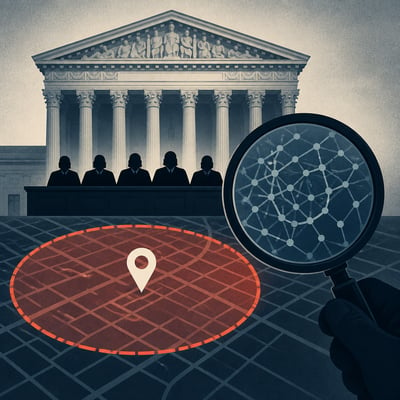
The U.
S. Supreme Court held in Chatrie v. United States that obtaining historical cellphone location data through a geofence warrant is a Fourth Amendment search. The ruling recognizes a privacy interest in granular location records held by companies such as Google, but it does not prohibit geofence investigations outright. The case returns to lower courts to determine whether the specific warrant met requirements for probable cause, particularity, and a sufficiently limited disclosure process.
The current version does not materially change the story. It mainly clarifies that lower courts will examine geographic and temporal limits, particularity, and the warrant’s narrowing process.
The current version clarifies that the Court did not categorically prohibit geofence warrants and emphasizes the case’s remand for review of the specific warrant and narrowing process. It also adds the ruling’s 6-3 vote and identifies civil-liberties groups involved in related filings.
The update sharpens the Supreme Court ruling by explicitly tying geofence acquisition of historical smartphone location data to Fourth Amendment search doctrine, while narrowing the unresolved questions to probable cause, particularity, provider procedures, and private collection limits. It also drops several previously highlighted downstream debates, suggesting the story has become more legally focused and less expansive.
The story adds a more explicit accounting of what Chatrie now covers and a new implementation signal: Google has already changed its Location History practices, reducing the availability of the kind of mass searches at issue. The current framing also broadens the ruling’s potential influence across several related movement-tracking technologies, though those downstream effects remain contested.
The story has shifted from a general Supreme Court dispute over geofence warrants to a more specific post-Chatrie legal baseline, where historical cellphone location data is now treated as a Fourth Amendment search and warrant standards appear tighter. The newer coverage also broadens the implications to other large-scale surveillance systems, especially automated license plate readers.
- June 2026 Chatrie ruling becomes the dominant legal event.
- Historical cellphone location data is explicitly treated as a Fourth Amendment search.
- Geofence warrants remain available but under narrower warrant standards.
- Legal debate now extends to automated license plate reader systems.
The story has shifted from a pending Supreme Court review of geofence warrants to a decided ruling that treats location data as Fourth Amendment-protected, while still leaving some reasonableness questions unresolved. That turns the case from a live constitutional dispute into a new rule-setting decision with broader implications for digital records.
- Supreme Court ruling now treats movement-revealing location data as Fourth Amendment protected.
- Court rejected opt-in Google location history as eliminating privacy expectations.
- Reasonableness and related warrant issues were left unresolved on remand.
- Potential spillover to other remotely stored digital records is now explicit.
The story remains centered on the same Supreme Court review without a material change in legal direction, scope, or urgency. Current coverage adds minor factual clarification about the 2019 investigation and the stepwise narrowing of Google's location data.
The main activity is the Supreme Court review of geofence warrants, with judges weighing whether police access to Google location data counts as a search and how tightly such requests must be limited. The strongest signal is a possible tightening of constitutional limits on bulk location-data collection, while law-enforcement utility remains the main counterargument.