
 AI Governance
 Data Centers
 Drones
 Climate
 Privacy
 2026 Maine Senate
 Bob Dylan
Flock Safety Surveillance Network
Coverage from Explainx, Daily Breeze, and others
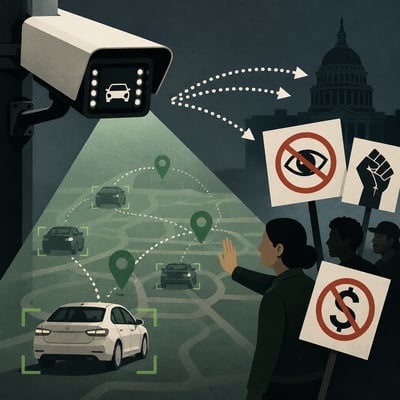
Flock Safety’s automated license plate reader network is expanding across U.
S. communities, allowing law-enforcement customers to search vehicle locations, partial plates, and visual characteristics over time. The systems are becoming part of broader data-fusion practices that may connect vehicle records with other government, commercial, and surveillance data. The expansion is prompting scrutiny over retention, access, algorithmic accuracy, immigration-related use, accountability, and whether persistent vehicle tracking requires stronger legal safeguards.
The story now includes named federal and Louisiana lawmakers preparing legislative restrictions on Flock and similar systems. It also sharpens the legal framing around persistent vehicle tracking and broad or unclear searches, though the underlying privacy concerns remain largely consistent.
The story now places greater emphasis on new usage and oversight concerns around Flock data, especially reported immigration-related searches in Florida and active restriction efforts in Louisiana. It also broadens from general license-plate surveillance disputes to potential data fusion with facial recognition, commercial data, and other government databases.
The story has become more concrete and operational: it now includes specific local deployments, audits, and contract decisions, alongside sharper policy disputes over AI training, accuracy, and warrant requirements. It also broadens beyond general privacy concerns to include tribal deployments and proposed federal restrictions.
- Idaho Falls imposed limits on AI training, searches, external sharing, and access.
- The Los Angeles Police Department audit found inaccurate stolen-vehicle alerts.
- Navajo Nation is deploying license plate readers across a large territory.
- Governments are requesting alternative systems and pausing deployments.
- Federal lawmakers are debating stronger funding restrictions and safeguards.
Flock Safety is expanding a connected network of automated license plate readers used by thousands of law-enforcement agencies to identify vehicles, recover stolen property, locate missing people, and generate investigative leads. The growth has intensified concerns that searchable vehicle sightings can reveal travel patterns, enable misuse, and allow local data to be shared across agencies, including with federal authorities. Communities are responding through contract cancellations, calls for stronger safeguards, litigation, activism, and proposed limits on public funding for ALPR deployments.