
 AI Governance
 Data Centers
 Drones
 Climate
 Privacy
 2026 Maine Senate
 Bob Dylan
Flock Safety Surveillance Backlash
Coverage from The Enterprise News, Wilson Times, and others
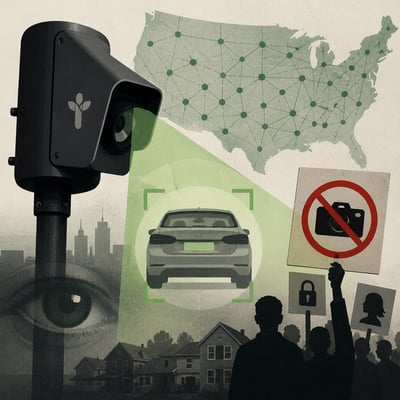
Flock Safety's rapidly expanding automated license plate reader network is under sustained U.
S. scrutiny as shared vehicle-location databases enable cross-jurisdiction searches, while reported misuse, inaccurate alerts, security weaknesses, and limited retention controls drive contract cancellations and new state and federal restrictions.
The story now quantifies the surveillance infrastructure's scale and adds evidence of false alerts and security exposure, while emphasizing that restrictions and contract decisions are moving from debate into implementation. The framing has broadened from opposition to Flock specifically toward systemic risks across a fragmented ALPR market.
The main new development is formal congressional scrutiny, including a scheduled Senate Judiciary subcommittee examination of Flock’s nationwide network. The current version also adds law-enforcement defenses of the technology, modestly balancing the predominantly critical framing.
The story is largely consistent, but new reporting adds concrete disputes in Washington, D.C., and Milwaukee over officer access, internal investigations, transparency, and audit controls. It also identifies Immigration and Customs Enforcement as a frequent Flock-network user, sharpening concerns about federal access to vehicle-location data.
The story now emphasizes a commercial response to the backlash, with Axon pursuing agencies reconsidering Flock, while revised cancellation estimates substantially qualify earlier claims of more than 200 affected jurisdictions. The underlying privacy and governance concerns remain largely unchanged.
The story has broadened from opposition to Flock Safety into a wider governance dispute over networked ALPR systems, including privately deployed cameras and inconsistent safeguards across agencies. Reported contract losses have also grown from more than 100 to more than 200 jurisdictions, strengthening the evidence of nationwide backlash.
The controversy has intensified, with reported withdrawals now exceeding 100 jurisdictions and opposition becoming more prominent during the summer. The current version otherwise largely confirms the established privacy, regulatory, and vendor-substitution concerns.
The backlash has moved beyond local contract decisions and vendor safeguards toward concrete legislative proposals, including federal funding restrictions targeting AI-enabled surveillance cameras.
The update reframes the dispute around national-scale searchability and the limits of vendor safeguards, while explicitly identifying immigration authorities as a relevant data-access concern. Reports also suggest the number of communities rejecting Flock may be higher than previously indicated, though estimates vary.
The story is increasingly framed as a broader oversight and police-surveillance governance dispute, rather than a series of isolated privacy incidents. However, the underlying allegations, cancellations, safeguards, and vendor competition remain largely unchanged.
The story now presents opposition as broader and more operational, with more than 100 communities reportedly reconsidering Flock and officials using contract reviews, permit actions, funding pauses, and referendums. The emphasis has shifted toward concrete local efforts to halt or condition deployments.
The story is increasingly framed as a broader debate over automated license plate reader networks and whether vendor safeguards and public oversight can prevent abuse, rather than simply whether Flock aids investigations.
The update largely confirms the existing backlash and policy scrutiny, while sharpening the conclusion that replacing Flock with another vendor may not resolve persistent vehicle-tracking concerns. It also adds clearer law-enforcement defenses and identifies Senator Josh Hawley as an active congressional investigator.
The current version largely confirms the existing account of sustained scrutiny and commercial pressure on Flock Safety, without introducing a materially new event or outcome. It modestly broadens the geographic and official-policy framing but does not substantially change the story’s significance.
The controversy is broadening into a formal policy fight, with cities, state legislatures, and Congress considering restrictions, transparency rules, and limits on police access. Reported defections have also surpassed 100 communities, indicating intensified institutional pressure on Flock.
The story broadens beyond misuse and retention disputes to include cybersecurity, transparency, and camera-coverage concerns affecting a wider range of users and communities. Newly identified advocacy groups, a local police department, and Flock’s CEO sharpen the competing positions, but the core controversy remains unchanged.
The controversy has moved beyond proposed oversight toward concrete government and commercial responses: Texas halted state funding, while Axon and other vendors pursued replacement contracts. The story is also increasingly framed as a broader networked-surveillance problem rather than one limited to Flock.
The update adds concrete actors and a specific enforcement response: Milwaukee police paused facial-recognition activity amid alleged misuse, while named civil-liberties groups and lawmakers sharpen scrutiny of Flock’s safeguards.
The story now emphasizes the scale and operational risks of ALPR networks, adding evidence of widespread alert inaccuracies while acknowledging continued law-enforcement demand. This shifts the focus from opposition to Flock specifically toward broader questions about the technology's reliability and expansion.
The story now includes a clearer commercial backlash: agencies reconsidering Flock are creating replacement opportunities for several competing surveillance vendors. Reporting also broadens the alleged misuse concerns to abortion-related travel and highlights skepticism that switching vendors would resolve underlying tracking and access risks.
The story adds a more concrete account of accuracy-related risks, linking incorrect alerts to potential wrongful stops and safety harms. It also gives greater prominence to law-enforcement benefits, modestly reframing the dispute as a tradeoff between investigative utility and surveillance risks.
The backlash is now quantified as affecting roughly 100 communities and a network exceeding 120,000 readers, while opposition has broadened into proposals for warrant requirements, purchase restrictions, and national rules. New advocacy and vendor activity further highlight both organized resistance and commercial fallout.
Flock Safety’s connected automated license-plate-reader network is expanding across U.S. communities while facing opposition from privacy advocates, residents, and some municipalities. Reported cases of unauthorized searches and alleged stalking, concerns about immigration and abortion-related investigations, cross-jurisdictional data access, and false matches have intensified scrutiny. Flock has proposed shorter retention and additional auditing and search safeguards, but critics argue that provider-level changes do not resolve broader questions about police oversight and mass vehicle tracking.