
 AI Governance
 Data Centers
 Drones
 Climate
 Privacy
 2026 Maine Senate
 Bob Dylan
Flock Safety Faces Surveillance Pushback
Coverage from Richmondside, Nashville Tennessean, and others
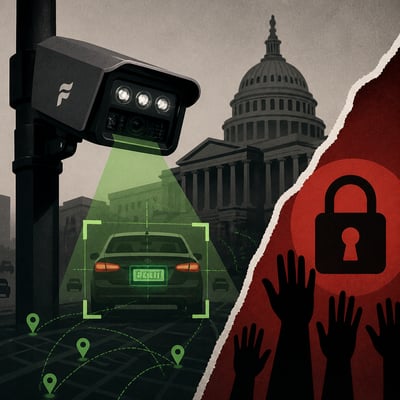
Flock Safety automated license plate reader networks are expanding across U.
S. communities while officials, residents, and civil-liberties groups contest their implications for location privacy, data sharing, and government access. Supporters cite investigations, vehicle-theft recovery, missing-person cases, and public-safety benefits; opponents argue that searchable records of ordinary drivers can enable persistent tracking and misuse, especially when networks connect across jurisdictions. Local contract decisions and proposed state and federal restrictions are increasingly focusing on retention limits, authorized users, funding, transparency, and cross-border access.
The story now centers more explicitly on local activation and renewal fights, with communities deciding whether to turn systems on, keep them, pause them, or remove them. It also sharpens the policy angle by foregrounding a specific federal bill and stronger concerns about interconnected tracking and misuse.
The story has broadened from local debate over Flock deployments and retention to a more explicit policy fight over federal and state restrictions on purchases, funding, access, and permissible uses. It also adds new local cases and sharper concern over unauthorized searches and outside-agency access.
- Some jurisdictions reportedly retain Flock records for up to 90 days.
- Federal and state proposals would limit purchases, funding, users, placement, retention, and purposes.
- Georgia appears as a new state in the debate.
- Reported arrests and unauthorized searches are intensifying oversight demands.
The story now emphasizes concrete policy responses: some jurisdictions have delayed or restricted Flock deployments, and lawmakers have moved from debate to enacted or proposed limits on surveillance, retention, and funding. The federal and state regulatory angle is more prominent than before.
- Several jurisdictions have delayed, restricted, declined, or reconsidered deployments.
- Washington enacted state-level controls on camera placement, retention, authorized users, and permitted purposes.
- A proposed federal bill would restrict federal use and funding for persistent or mass-surveillance technologies.
- Local debates now explicitly include Arizona.
- Policy actions now span January through August 2026 with some deployments still under review.
The story shifts from a general account of Flock Safety’s spread and backlash to a more policy-driven fight over concrete safeguards, with local governments and lawmakers now actively setting rules on access, retention, and funding. The updated framing also broadens the privacy concern from general surveillance to explicit worries about immigration-related access and persistent travel reconstruction.
- Local decisions now include shutdowns, delayed expansions, renewals with added controls.
- Immigration-enforcement access concerns are now central in several states.
- Lawmakers are considering limits on camera placement, retention, and authorized users.
- Cleveland renewed a Flock contract with added privacy protections.
- Washington State passed ALPR rules on placement, retention, and permitted purposes.
The story shifts from broad scrutiny of Flock Safety to a more concrete account of where deployments are expanding or being pulled back, with greater emphasis on local governance outcomes. The new version highlights actual cancellations, defunding, decommissioning, and renegotiation actions, while also sharpening the focus on retention and cross-jurisdiction data-sharing limits.
- Contract cancellations, defunding, decommissioning, and renegotiation are now occurring.
- Some jurisdictions permit retention far beyond 30 days, including 365-day settings.
- Interstate and interagency access is now a central governance issue.
- Federal legislation targets warrantless and publicly funded automated surveillance.
- The constitutional status of persistent ALPR tracking remains unsettled.
Flock Safety’s automated license plate reader network and related surveillance products are facing growing scrutiny from lawmakers, local officials, civil liberties groups, and some communities across the United States. Critics argue that broad data access, retention, cross-agency sharing, and expansion into new AI-enabled capabilities can turn targeted policing tools into systems for routine location tracking or other uses, while police and the company emphasize investigations, stolen-vehicle recovery, and missing-person cases. The resulting debate is driving contract reviews, proposed funding restrictions, state regulation, and demands for stronger safeguards.