
 AI Governance
 Data Centers
 Drones
 Climate
 Privacy
 2026 Maine Senate
 Bob Dylan
Flock Cameras Test Public Surveillance Limits
Coverage from Daily Pilot, Gainesville Public Information Services, and others
Flock Safety automated license plate readers are expanding across U.
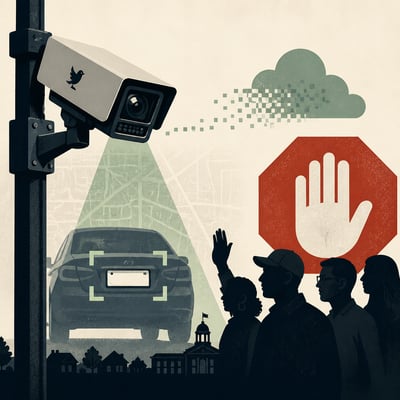
S. communities while local officials, residents, and privacy advocates challenge how the systems collect, retain, and share vehicle-location data. Police and the company cite benefits for crime investigations and missing-person cases, while critics point to networked tracking, immigration-related access, misuse incidents, and limited oversight. Cities and states are responding through contract changes, suspensions, removals, proposed federal restrictions, and new rules governing placement, retention, and authorized use.
The story now emphasizes concrete governance responses rather than expansion alone, including implemented restrictions on camera placement, retention, access, and permitted uses. It also adds more specific misuse allegations and identifies immigration-related sharing as a particularly prominent flashpoint.
The story shifts modestly from general debate toward concrete, divergent local responses, including suspensions, nonrenewals, removals from grant programs, and tighter access agreements. Reported misuse is also framed as increasing pressure for audits and clearer governance, though the underlying privacy concerns remain consistent.
The story now includes a concrete nonrenewal decision by Los Angeles police and sharper detail about typical retention periods and uneven access controls. Opposition is also more explicitly organized around civil-liberties concerns, while the broader policy debate remains fragmented rather than fundamentally changed.
The story now includes concrete Texas restrictions and a failed congressional effort to limit federally funded ALPR use, underscoring that policy responses remain fragmented rather than settled. Richmond also emerged as a new local test of whether reactivation can proceed with tighter safeguards.
The story now emphasizes concrete local reversals and conditional renewals, rather than debate alone, while proposed federal restrictions elevate the governance dispute beyond individual jurisdictions. These actions increase pressure for broader standards governing interconnected ALPR networks.
The story has moved from emerging and uneven policy debates toward concrete state-level intervention. Florida revoked highway-right-of-way approvals, Texas halted state funding, and Washington enacted operational rules for ALPR systems.
The story now emphasizes concrete governance responses to expanding Flock networks, including state regulation, contract safeguards, restricted access, and proposed federal funding limits. Security failures and disputed retention exceptions have intensified concerns beyond the earlier debate over expansion and sharing.
Communities across the United States are reassessing Flock Safety automated license plate reader networks as residents, privacy groups, and some officials challenge their expansion, data-sharing practices, retention periods, and limited public consultation. Law-enforcement agencies continue to cite stolen-vehicle recovery, missing-person investigations, and suspect identification as benefits, while several municipalities have paused installations, ended contracts, or withdrawn funding. The disputes center on whether interconnected vehicle-location data can be governed without enabling broad movement tracking, unauthorized access, or use against vulnerable communities.