
 AI Governance
 Data Centers
 Drones
 Climate
 Privacy
 2026 Maine Senate
 Bob Dylan
Flock Cameras Test Local Privacy Limits
Coverage from Port City Daily, Blue Ridge Now, and others
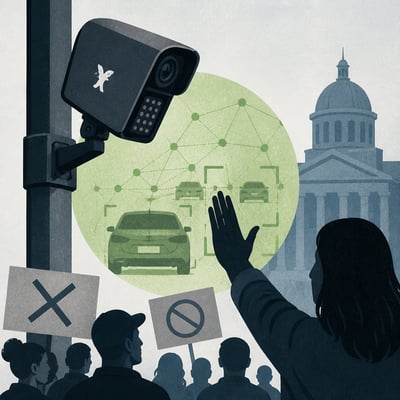
Communities across North Carolina are contesting Flock Safety automated license plate readers as the systems spread through police agencies, state authorities, private entities, universities, and homeowners associations.
Supporters cite stolen-vehicle investigations, arrests, and missing-person recoveries, while opponents question persistent vehicle tracking, interagency access, data retention, misuse, and public oversight. Local responses range from continued operation and proposed safeguards to contract cancellations, nonrenewals, and camera removals.
If you read one thing
It provides the broadest evidence-backed overview of Flock's expanding network, local resistance, access rules, and accountability concerns.
Latest development
It captures the major recent escalation in which New Hanover County ended its contract amid documented safeguard and misuse concerns.
The evidence
It adds concrete evidence of employee misuse, cross-jurisdictional tracking, and subsequent changes to retention and search auditing.
Local deployment is fragmenting under opposition
North Carolina jurisdictions are taking divergent paths: Macon, Pittsboro, Hillsborough, New Hanover, and Greenville have declined, cancelled, removed, or halted deployments, while state authorities and other agencies continue to operate or expand access. The result is an uneven deployment landscape rather than a uniform retreat.
Networked access is extending surveillance reach
Flock data is accessible beyond the agency operating a camera through customer-agency sharing, private and university systems, and state-level participation. Vehicle-location searches can therefore cross jurisdictional and organizational boundaries, including to agencies without direct Flock contracts.
Misuse evidence is driving a safeguards response
Unauthorized searches, alleged stalking, and employee misuse continue to expose weaknesses in oversight and verification. Flock and participating agencies have responded with audits, case-number requirements, access restrictions, and shorter retention periods, but misuse investigations and disputed controls keep accountability unresolved.
30 days
Raleigh police data-retention period
“Raleigh police use it to support criminal investigations and public safety. The department deletes data after 30 days and prohibits access for immigration enforcement unless it is tied to a criminal investigation.”
$219,000 USD
contract cost
“The New Hanover County contract cost $219,000 and funded 36 cameras.”
36 cameras
automated license plate reader cameras funded
“The New Hanover County contract cost $219,000 and funded 36 cameras.”
nine cameras
Flock cameras removed by Pittsboro
“Pittsboro canceled its contract and removed nine cameras in May after resident pushback. Hillsborough also canceled its contract and removed cameras over data-sharing concerns.”
Potential Flock misuse cases come under state investigation
Concerns over Flock governance have escalated as potential misuse cases in Brunswick County and Wrightsville Beach come under review by North Carolina’s State Bureau of Investigation, adding formal state scrutiny to existing disputes over safeguards and access controls.
Previously
Communities across North Carolina are contesting Flock Safety automated license plate readers as the systems spread through police agencies, state authorities, private entities, universities, and homeowners associations. Supporters cite stolen-vehicle investigations, arrests, and missing-person recoveries, while opponents question persistent vehicle tracking, interagency access, data retention, misuse, and public oversight. Local responses range from continued operation and proposed safeguards to contract cancellations, nonrenewals, and camera removals.
The story now extends beyond public law enforcement: private entities, universities, and homeowners associations are participating in connected Flock networks, making governance of cross-customer searches a broader regional issue. Local resistance has also advanced from proposed removals and nonrenewals to cancelled installations.
The dispute has broadened from local deployment decisions into a statewide network-access and misuse controversy. North Carolina SBI access to highway-camera data and reported employee searches in South Carolina add concrete evidence that interconnected systems create governance risks.