Last Update: 09/22/2026 at 11:34 PM EST

Child Social Bans Test Age Privacy

Coverage from Bitget, CounterPunch, and others
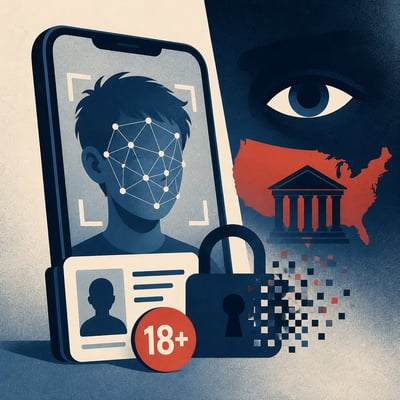
Child Social Bans Test Age Privacy topic image

The United Kingdom is developing an under-16 social-media restriction expected to take effect in spring 2027, requiring platforms such as TikTok, Instagram, YouTube, Snapchat, Facebook, and X to establish users’ ages.

The policy has made age assurance a central privacy and cybersecurity issue because implementation may involve identity documents, facial age estimation, or third-party verification systems that could expose sensitive data, reduce anonymity, and remain vulnerable to circumvention. Similar proposals in the European Union and existing U.S. state laws indicate that age-gated access is becoming a broader regulatory trend, although effectiveness and privacy safeguards remain unsettled.

Key Articles4 of 54 articles

If you read one thing

It provides the clearest overview of the UK proposal and its central tension between child-safety enforcement and privacy-preserving age assurance.

Techtimes / Kyle Belmonte

Latest development

It materially updates the topic by showing how the EU is broadening age-based child-safety regulation and pairing restrictions with new verification requirements.

The Record / Suzanne Smalley

The evidence

It supplies concrete evidence of the privacy and security risks created when platforms and vendors use identity or biometric checks.

Fortune / Catherina Gioino

The evidence

It demonstrates the enforcement gap through reported bypass methods and survey evidence that existing age checks can be evaded.

Yahoo
Key Issues

Prescriptive age regulation is broadening

Child-access rules are expanding across jurisdictions and moving toward defined age thresholds, supervised accounts, platform duties, and operating-system age signals. The UK proposal is becoming more operationally specified while EU, Australian, and U.S. measures broaden the regulatory direction beyond one national framework.

Strengthening

Drawn from 4 articles

Age assurance remains a privacy trade-off

Enforcement continues to risk normalizing identity documents, biometric checks, credit-card data, and behavioral age inference for ordinary online access, potentially affecting adults as well as minors. Privacy-preserving designs coexist with platform-level estimation and unresolved data-custody, breach, anonymity, and access concerns.

Drawn from 5 articles

Enforcement effectiveness remains uncertain

Existing regimes show a persistent gap between formal age restrictions and reliable exclusion: minors can use fake accounts, VPNs, altered appearances, or other workarounds. Verification also creates user friction and broad data-collection requirements, so the evidence supports stronger compliance activity but not dependable prevention of underage access.

Drawn from 3 articles

Blanket restrictions face legal and rights constraints

Recent legal scrutiny is challenging broad youth social-media bans and universal age verification as disproportionate, insufficiently safeguarded, or burdensome to privacy and expression. Policymakers are consequently balancing access restrictions with narrower designs, parental controls, platform duties, and privacy-preserving alternatives.

Drawn from 4 articles

Key Numbers

15 years

minimum age targeted by the social-media ban

persons under the age of 15 years

On August 14, France's Constitutional Council struck down legislation banning the use of social media by persons under the age of 15 years, a law that had been passed making France the first European country to do so.

CounterPunch

6% of global annual sales

maximum proposed company fine

Very large providers would submit compliance plans to the Commission and a third-party auditor. The Commission said investigations into suspected violations would be accelerated and completed within 90 days. Companies could face fines of up to 6% of global annual sales and would have to pay fees supporting regulatory oversight.

The Record

90 days

proposed maximum investigation timeline

for suspected violations

Very large providers would submit compliance plans to the Commission and a third-party auditor. The Commission said investigations into suspected violations would be accelerated and completed within 90 days. Companies could face fines of up to 6% of global annual sales and would have to pay fees supporting regulatory oversight.

The Record

15 years

proposed minimum account-creation age

bloc-wide

The European Commission laid out a roadmap for the EU KIDS Act, a proposal that would bar children under 13 from accessing social media and establish a bloc-wide minimum account-creation age of 15. Children ages 13 to 15 would require guardian-created “mini accounts,” with limits on social contacts and screen time.

The Record

14- and 15-year-olds years

age group for proposed parental consent

parental consent alternative in the Australian challenge

The challenge argues that Australia's ban places a heavy burden on political communication and that less restrictive alternatives exist, including parental consent for 14- and 15-year-olds, platform duty-of-care and safe-design settings, targeted moderation, age-appropriate feature controls, digital literacy programs and privacy-preserving age assurance.

CounterPunch

Looking Back
219 Day Timeline
Feb 12Mar 26May 7Jun 18Jul 30Sep 10
The Story So Far
Broadening

EU child-access rules broaden beyond social media to games and AI services

The EU has moved from considering coordinated child-access restrictions to outlining a Kids Act that would bar social-media access for under-13s, set a bloc-wide account age of 15 with supervised accounts for younger teens, and impose safety-by-design duties across social media, online games, video services, and AI chatbots. The framework would pair a privacy-preserving verification app with platform age estimation and substantial compliance penalties, preserving concerns about universal age checks and adult privacy.

Previously

Governments are tightening controls on young people’s access to social media, with the UK and Malaysia moving toward under-16 restrictions and EU officials considering coordinated action. Enforcement increasingly depends on age checks involving government IDs, facial analysis, credit cards, or other identity signals, extending verification requirements to many adults who create new accounts. The measures are intended to reduce exposure to harmful content and platform-driven harms, but they also raise concerns about biometric-data breaches, loss of anonymity, circumvention, and uneven effectiveness.

History
09/17/2026

The UK proposal is now more concretely defined, with Ofcom positioned to oversee age-assurance standards and a clearer distinction between covered platforms and exemptions. The regulatory trend also broadens geographically through newly noted Australian and U.S. measures.

07/23/2026

The story now places greater emphasis on a broader regional move toward age-gating, with EU and several European countries potentially joining the UK and Malaysia. It also adds that verification requirements are increasingly affecting ordinary adults creating new accounts, not just minors.

All Articles54 articles
Important22 articles · CI Score 60 and above
Bitget
States enact age verification rules in 2025 across the United States targeting social media platforms.
3/2/2026 • Data Collection & Surveillance Practices • General
CounterPunch / Binoy Kampmark
France's Constitutional Council struck down an under-15 social media ban on August 14 after finding disproportionate restrictions on rights and inadequate privacy safeguards for age verification.
9/1/2026 • Regulation, Law & Enforcement • General
EFF / Paige Collings
France's Constitutional Council struck down the planned under-15 social media ban and adult age-verification requirement in France earlier this month.
8/26/2026 • Regulation, Law & Enforcement • General
Techtimes / Kyle Belmonte
Britain will restrict under-16 access to major social platforms under the Online Safety Act, with enforcement in spring 2027 pending legislation and unresolved age-verification privacy tradeoffs.
6/16/2026 • Regulation, Law & Enforcement • General
PCMag
California is set to require operating systems to collect user age during setup and share age-range signals with apps from 2027 onward.
6/10/2026 • Regulation, Law & Enforcement • General
The Record / Suzanne Smalley
The European Commission proposed the EU KIDS Act in the European Union to impose child-access limits and age verification across online services.
9/17/2026 • Regulation, Law & Enforcement • General
Yahoo
Ofcom investigated TikTok on July 16 over possible failure of underage detection as Australia, the U.K., and France implement stricter social-media bans for minors.
7/21/2026 • Regulation, Law & Enforcement • General
Data Matters Privacy Blog
Australia implemented a December 10, 2025 minimum-age social media law, prompting global moves toward age verification, design mandates, and advertising limits for minors.
2/13/2026 • Regulation, Law & Enforcement • General
Time / Callum Sutherland
The United Kingdom government, with Ofcom age-assurance oversight, proposes under-16 bans on major social platforms ahead of spring 2027 implementation.
6/16/2026 • Regulation, Law & Enforcement • General
Ars Technica / Jon Brodkin
The UK government announced a spring 2027 under-16 social media ban, with Ofcom tasked to set age assurance methods that platforms must use.
6/15/2026 • Regulation, Law & Enforcement • General
The New York Times / Adam Satariano; Jeanna Smialek
The European Commission proposed the EU Kids Act in Strasbourg, France, to restrict social media access for children under 15 across the European Union while policymakers debate privacy risks from age verification.
9/16/2026 • Regulation, Law & Enforcement • General
IAPP / Lexie White
France’s Parliament approved an under-15 social media ban on 21 July, requiring platform age verification with EU-wide enforcement implications.
7/22/2026 • Regulation, Law & Enforcement • General
ICO
The UK ICO said child online protection and social media access restrictions should align with existing data protection obligations while continuing enforcement against Reddit and Imgur.
6/15/2026 • Regulation, Law & Enforcement • General
CNET / Omar Gallaga
The European Commission proposed the EU Kids Act in the European Union to impose age limits, verification and safety requirements on social media, games and AI chatbot providers.
9/18/2026 • Regulation, Law & Enforcement • General
Yahoo
Internet Matters surveyed UK children and parents in 2025 and reported widespread beliefs that age verification rules are easy to bypass using facial spoofing and other tactics.
5/10/2026 • Regulation, Law & Enforcement • General
Fortune / Catherina Gioino
Regulators and privacy researchers scrutinize age verification methods on social platforms during the 2020s.
3/2/2026 • Personal Data & Identity • General
Future of Privacy Forum
Future of Privacy Forum commented on May 15 draft California DOJ rules for SB 976, advising flexible age assurance, clearer parental consent workflows, and narrower retention alignment.
7/15/2026 • Regulation, Law & Enforcement • General
Techdirt / Molly Buckley
Massachusetts, Idaho, Minnesota, North Carolina, South Carolina, Illinois, and California are considering social media bans for minors using age verification or behavioral age estimation systems.
6/29/2026 • Consumer Privacy & Digital Rights • General
QueerAF
UK government announced a social media access ban for children under 16, with age verification requirements scheduled for spring 2027, raising concerns about identity data security.
6/20/2026 • Consumer Privacy & Digital Rights • General
EFF / Molly Buckley
Several U.S. states advance youth social media age-gating proposals that require identity verification or behavioral age estimation, according to privacy advocates.
6/8/2026 • Consumer Privacy & Digital Rights • General
Dark Reading / Robert Lemos
Keir Starmer announced in the UK a 2027 start for restricting adolescent access to major social media and some AI chatbot services, prompting privacy and age-verification criticism.
6/17/2026 • Consumer Privacy & Digital Rights • General
BleepingComputer / Ax Sharma
The UK government will implement a spring 2027 ban on under-16s from social media, requiring platforms to verify age via ID upload or facial scans for new accounts.
6/16/2026 • Consumer Privacy & Digital Rights • General
Interesting29 articles · CI Score 45–59
NBC News
UK lawmakers advance age-gating social media access for under-16 users using ID, payment, or face-scan checks, prompting privacy and anonymity backlash.
6/16/2026 • Regulation, Law & Enforcement • General
NBC News
Malaysia began enforcing under-16 age-verification rules for large social media platforms to limit harmful content and cyberbullying, with penalties up to 10 million ringgit.
6/1/2026 • Regulation, Law & Enforcement • General
SDM Magazine
Industry vendors and adopters describe growing biometric access control deployments as state biometric laws and privacy requirements influence transparency and user-choice practices.
7/6/2026 • Personal Data & Identity • General
IAPP / Lexie White
On 15 June 2026, the U.K. government proposed Ofcom-enforced social media and AI interaction restrictions to limit children under 16 and 18 from platform access and explicit chatbot use.
6/15/2026 • Regulation, Law & Enforcement • General
404 Media / Samantha Cole
Headway announced an April 3 identity verification change using government ID photos and facial biometric scanning for clients and providers.
5/28/2026 • Personal Data & Identity • General
ArcaMax
Minnesota lawmakers passed a social media parental consent and age-verification bill for children under 16, and Gov. Tim Walz is reviewing the measure for potential signing amid expected legal challenges.
5/23/2026 • Regulation, Law & Enforcement • General
WWLP / Ella Adams
Massachusetts advocates opposed H 5366 after House passage of under-14 social media restrictions, citing privacy risks in age verification methods and impacts on LGBTQ youth.
5/14/2026 • Regulation, Law & Enforcement • General
Shacknews / TJ Denzer
Governor Gavin Newsom signs AB 1043 in California, mandating age verification at OS startup across Windows, Mac, Linux, iOS, Android, and SteamOS, effective January 2027.
2/27/2026 • Regulation, Law & Enforcement • General
CNBC
Australia in 2025 bars social media accounts for under 16s, with penalties up to 49.5 million AUD for noncompliance.
2/23/2026 • Regulation, Law & Enforcement • General
Data Matters Privacy Blog / Sidley Data Matters Contributors
U.S. state lawmakers and regulators advance minors privacy protections and age verification requirements in 2025 across the United States.
2/12/2026 • Regulation, Law & Enforcement • General
New York Magazine / John Herrman
BMJ researchers reported in 2026 that Australia's December 2025 Online Safety Amendment for under-16 social media accounts was lightly implemented and commonly bypassed.
7/6/2026 • Consumer Privacy & Digital Rights • General
ZeroHedge / Tyler Durden
Meta and Uber and other service providers increasingly require selfie and driver license verification for access, while Florida HB 3 and the UK Online Safety Act expand age-check requirements.
6/23/2026 • Personal Data & Identity • General
Dallas News
US lawmakers propose app-store age verification and parental consent, but critics cite reduced local-news access and increased risk from collecting sensitive identity data.
6/18/2026 • Consumer Privacy & Digital Rights • General
WRAL
North Carolina senators approved House Bill 301 restricting social media accounts for children 13 and younger, requiring parental consent for ages 14-15 and expanding education standards for AI instruction.
6/9/2026 • Regulation, Law & Enforcement • General
The Guardian / Dan Milmo
Keir Starmer announced a UK ban limiting under-16 access to major social platforms beginning next spring, affecting livestreaming and chat permissions for older teens.
6/15/2026 • Regulation, Law & Enforcement • General
CNET / Katie Collins
Keir Starmer says the UK will legislate before Christmas to ban children under 16 from major social media platforms using age assurance, with effects by spring 2027.
6/15/2026 • Regulation, Law & Enforcement • General
The Record / Suzanne Smalley
Ursula von der Leyen said the European Union could propose by summer age limits for social media access for children, alongside design-practice restrictions.
5/13/2026 • Consumer Privacy & Digital Rights • General
EFF / Paige Collings
EFFs Pride Q&A describes privacy and safety risks in UK over-18 age verification systems and warns about sensitive data inferences for LGBTQ users.
6/30/2026 • Consumer Privacy & Digital Rights • General
EFF / Paige Collings
UK policymakers plan a Spring 2027 ban on social media access for under-16 users, requiring age assurance measures and imposing access limits tied to online safety rules.
6/19/2026 • Consumer Privacy & Digital Rights • General
EFF / Rindala Alajaji
California A.B. 2071 is presented as a targeted alternative to broader youth social media bans amid concerns about unsettled evidence and privacy-implicating compliance.
5/13/2026 • Consumer Privacy & Digital Rights • General
Gadgetreview
Ofcom and UK authorities report widespread child age-verification bypass attempts involving fake IDs, VPNs, and deepfakes to defeat facial recognition.
5/4/2026 • Consumer Privacy & Digital Rights • General
Newsmax / Eileen Ng
Malaysia started enforcing under-16 social media account restrictions with required age verification, raising privacy concerns about government ID use.
6/1/2026 • Regulation, Law & Enforcement • General
AP News / Eileen Ng
Malaysia enforces under-16 social media age-verification rules in 2020s, requiring platforms including Meta and TikTok to block accounts for covered users.
6/1/2026 • Regulation, Law & Enforcement • General
The Record / Suzanne Smalley
France approved a social media access ban for children under 15, with enforcement beginning September 1 for new accounts and January 2027 for existing accounts.
7/22/2026 • Regulation, Law & Enforcement • General
CNET / Katie Collins
Ursula von der Leyen announced EU proposals for age-verified social media access limits for children under 13, with phased parental consent controls and Digital Services Act enforcement.
7/13/2026 • Regulation, Law & Enforcement • General
Yahoo / Lauren MacDougall
Keir Starmer announced an under-16 social media ban covering TikTok and Snapchat, with implementation expected by spring 2027, prompting divided public views on enforceability and privacy impact.
6/15/2026 • Policy, Politics & Governance • General
European Commission
European Commission special panel finalized recommendations in July 2026 to strengthen age-appropriate platform protections for children using social media and AI services.
7/13/2026 • Consumer Privacy & Digital Rights • General
U.S. News
Malaysia began enforcing age-verification rules blocking social media accounts for users under 16, requiring major platforms to comply or face penalties while triggering privacy concerns.
5/31/2026 • Consumer Privacy & Digital Rights • General
The Record / Suzanne Smalley
Ursula von der Leyen proposed a harmonised EU age-13 threshold for children joining social media to address safety and mental harm risks as member states consider stricter limits.
7/13/2026 • Consumer Privacy & Digital Rights • General
Additional3 articles · CI Score below 45
Insurance Journal / Alicia Clanton
California lawmakers propose a minimum age of 16 for social media accounts, triggering privacy and free-speech litigation risks tied to age-verification data.
3/19/2026 • Consumer Privacy & Digital Rights • General
The Record / Suzanne Smalley
UK Prime Minister Keir Starmer announced a 2027-enforced under-16 social media ban using age assurance, livestream and stranger-communication blocks, and restricted intimate AI chatbot features.
6/16/2026 • Consumer Privacy & Digital Rights • General
East Bay Times
California lawmakers propose minimum age limits for social media, and privacy advocates warn age verification could require personally identifiable information and raise breach risks.
3/18/2026 • Consumer Privacy & Digital Rights • General