
 AI Governance
 Data Centers
 Drones
 Climate
 Privacy
 2026 Maine Senate
 Bob Dylan
Police AI Expands as Rules Lag
Coverage from CircleID, Courthouse News, and others
U.
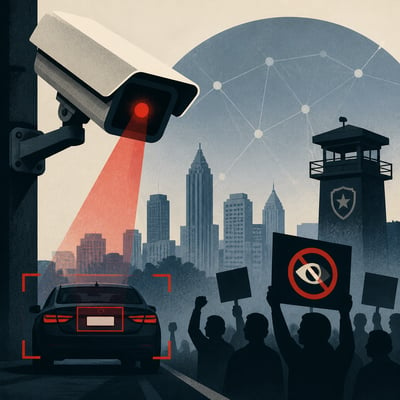
S. law-enforcement agencies are expanding AI use to search video, analyze digital evidence, draft reports, identify patterns, and monitor people or facilities. The same capabilities can broaden surveillance and accelerate investigative work while making bias, system errors, source traceability, and courtroom challenges more difficult to manage. California and Utah have adopted disclosure and safeguard requirements for some police uses, but regulation remains fragmented across states and technologies.
The story has shifted from broad AI-enabled surveillance expansion to a more specific emphasis on generative AI in police evidence work and reporting, alongside emerging state-level guardrails. The current version also foregrounds a few local deployments and vendors that make the rollout more concrete.
The story broadens materially from local police-camera controversy to a wider public-surveillance regime, adding Germany’s newly approved federal powers and more integrated camera, drone, and behavioral-recognition deployments. The emphasis shifts toward governance gaps across diverse systems, not just Flock Safety backlash.
- German Bundestag approved broader federal surveillance powers.
- Behavior recognition and telecommunications monitoring were added to the surveillance toolkit.
- Operational deployments are enabling faster suspect and vehicle identification.
- Some systems, including Harris County jail cameras, remain exploratory.
- Retention, auditability, and access controls vary significantly across agencies and vendors.
The story now centers more sharply on Flock Safety as the main flashpoint, with specific city actions showing local backlash has moved from general concern to concrete contract suspensions and removals. The framing also tightens around camera surveillance and federal access concerns, while broadening the emphasis on ordinary connected devices as part of the surveillance ecosystem.
The story has broadened from general concerns about police surveillance to a more specific pattern of local resistance and formal rulemaking. The main new development is that some Flock Safety deployments are now facing active cancellations, lawsuits, and state-level safeguards rather than just public criticism.
- Flock Safety programs now face lawsuits and shutdown orders.
- California and Utah have begun regulating some police generative AI uses.
- Smart glasses are newly cited as part of routine recording expansion.
- Federal agencies like DHS and ICE are more explicitly part of the dispute.
The story broadens from police and municipal surveillance to a wider ecosystem that now includes consumer connected cameras and federal surveillance activity, while the backlash around Flock Safety becomes more concrete through cancellations and removals. The framing also shifts toward a more explicit debate over efficiency versus privacy, bias, and control.
- Police are using AI for report writing and drone operations.
- Some US cities are canceling Flock Safety contracts or ordering removals.
- Consumer doorbell cameras are now part of the surveillance debate.
- US Department of Homeland Security is cited as expanding AI surveillance.
- Supporters emphasize efficiency, crime prevention, audit logs, and human review.
The story has broadened from local deployment of AI camera systems to a clearer, more politically charged backlash over surveillance governance, with new attention to major vendors, federal action, and contested transparency practices. It now reads less like a rollout update and more like an escalating debate over who can collect, share, and use public-space data.
- Flock Safety is now a recurring vendor and backlash target.
- Germany's Bundestag passed a law expanding police AI and surveillance powers.
- Some cities are questioning or reversing deployments after transparency complaints.
- Milwaukee police and Houston city government are newly named in the story.
- Facial recognition and AI search functions are now highlighted as a distinct concern.
The story now emphasizes conditional public acceptance of AI surveillance when safeguards exist, adding survey-based support to the earlier focus on expansion and opposition.
The story has broadened from general city surveillance expansion into a more specific present-tense wave of AI camera deployment tied to policing, traffic control, and beach monitoring. The update also adds clearer evidence of pushback and tighter oversight actions in several cities.
The story broadens from a general city-surveillance debate into a more explicit account of active expansion, vendor contestation, and local pushback over data sharing and retention. It also adds new actors and use-cases, including LiveView Technologies, Western Digital, and more emphasis on camera-network and facial-recognition concerns.
The story broadens from camera and license-plate networks to integrated systems involving drones and centralized monitoring, with greater emphasis on data access and search controls.
The story broadened from a city-camera and Cop City controversy into a wider account of AI public-safety surveillance, with new emphasis on real-time analytics, facial recognition, and conditional public acceptance. The center of gravity also shifted toward specific guardrails—notice, retention limits, and auditability—rather than only outright resistance.
The story has broadened from Atlanta’s Cop City-centered surveillance buildup into a wider US fight over AI camera systems, with more cities actively restricting or challenging Flock Safety deployments. The emphasis has shifted from a local surveillance expansion to a broader governance and civil-liberties conflict across municipal councils and resident campaigns.
- Multiple US cities are now actively challenging or reducing Flock Safety deployments.
- Surveillance disputes are moving into council meetings and lawsuits.
- AI video analytics are being described as real-time interpretation and automated flagging.
- Concerns now include cybersecurity, retention, and governance gaps.
- The story now includes broader municipal surveillance systems beyond Atlanta.
Atlanta is expanding AI-enabled camera surveillance through the Cop City training facility and related local contracts, with license-plate readers, real-time monitoring, and broad community pushback over mass surveillance and oversight.