
 AI Governance
 Data Centers
 Drones
 Climate
 Privacy
 2026 Maine Senate
 Bob Dylan
Rolling Thunder Revue’s Changing Second Act
Coverage from Flagging Down the Double E's, NJArts.net, and others
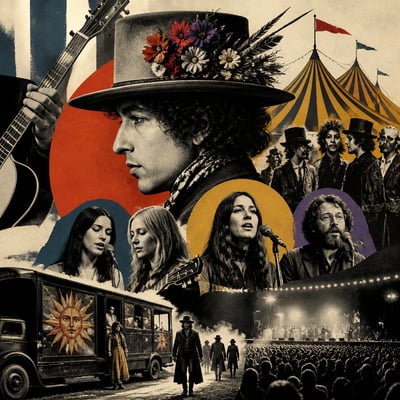
The Rolling Thunder Revue was Bob Dylan’s 1975–76 traveling ensemble, combining small-venue concerts, changing lineups, guest appearances, theatrical presentation, and related film work.
The material emphasizes a marked difference between the energetic, collaborative first phase and the more altered, less cohesive 1976 continuation, while archival releases and retrospective accounts continue to document the tour’s performances. Its significance rests primarily in the breadth of its collaborations, its benefit for Rubin “Hurricane” Carter, and the surviving recordings and recollections that illuminate the tour’s evolving form.
The story is now framed more sharply as a two-phase project, contrasting the cohesive, collaborative 1975 tour with a substantially altered and less cohesive 1976 continuation. It also newly foregrounds the Hurricane Carter benefit and the revue’s connection to Renaldo and Clara and Joni Mitchell’s “Coyote.”
The main change is a sharper emphasis on archival recovery and documentary reinterpretation of Rolling Thunder Revue, with new material highlighting setlist variation and recording restoration. The story also broadens slightly by adding Martin Scorsese's film and renewed debate over how the tour's history is framed.
The coverage more explicitly reframes Renaldo and Clara as an unstable hybrid of concert documentary and staged performance, while presenting the Revue as evidence of Dylan's shifting artistic roles. The underlying historical account and archival emphasis remain largely unchanged.
The framing shifts slightly from a broad retrospective on Rolling Thunder’s documentation and mythmaking to a more specific emphasis on the tour’s collaborative structure and the contrast between its strong early leg and weaker later phase. The current version also broadens the surrounding Dylan context by tying the Revue more explicitly to adjacent 1970s works.
The story broadens from Rolling Thunder itself to a more explicit comparison with later Dylan live eras, especially Street-Legal and the 1978 world tour. The framing also shifts toward a clearer emphasis on the tension between documentary record and mythmaking.
The story has broadened slightly from retrospective discussion of Rolling Thunder as a historical live project into a more specific emphasis on how the recorded archive continues to grow and be contested, including newly surfaced soundboard material and documentary ambiguity. It also now includes a small civic-preservation thread tied to the era.
Recent coverage revisits Rolling Thunder Revue as a durable reference point for Dylan's live evolution, with strong attention to archival releases, retrospective interviews, setlist shifts, and the changing feel of the 1975-76 tour. The material consistently returns to the tour's theatrical collaboration, its later 1976 recalibration, and the tension between documentation, myth, and performance history.