
 AI Governance
 Data Centers
 Drones
 Climate
 Privacy
 2026 Maine Senate
 Bob Dylan
Dylan, Simon, And Beatles Influence
Coverage from Jokerandthethief, The Metropolitan Review, and others
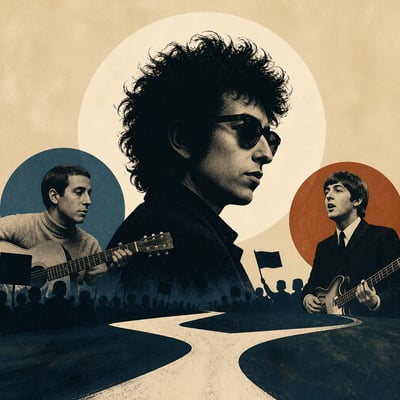
This material mostly revisits Bob Dylan as a benchmark songwriter whose influence shaped Paul Simon, the Beatles, and later critical comparisons.
The strongest thread is retrospective interpretation of Dylan's artistic status, especially his role in 1960s songwriting change and his continuing placement near the top of popular-music hierarchies. A smaller but important thread covers specific historical interactions, including Dylan's relationship to Simon & Garfunkel and the Beatles' reciprocal creative exchange. The signal is moderate rather than dense: the cluster is coherent around Dylan's legacy and influence, but it is fragmented across comparison pieces, retrospective essays, and one archival recording story.
The story has broadened from a fairly general Dylan-Simon-Beatles influence theme into a more structured retrospective around Dylan’s legacy, now adding Leonard Cohen, Simon & Garfunkel, and an archival recording angle. The biggest change is the new emphasis on a specific historical recording story that shows Dylan-related personnel helping turn "The Sounds of Silence" into a hit.
The story remains substantially stable, with only a slight reframing toward Dylan as a benchmark for evaluating songwriting and toward contrasts in lyrical method.
The story now frames the Dylan-Simon-Beatles material more explicitly as a single influence network, while adding later retrospective ranking commentary and a broader set of comparison points. It also introduces Randy Newman as a supporting reference for Dylan's songwriting tastes.
The story shifts from general Dylan-centered comparison pieces to a more specific canon-building frame centered on Dylan’s reciprocal influence with the Beatles, especially through 1960s meetings and later musical echoes. It also introduces Jim Windolf as an author pushing that Beatles-Dylan interpretation.
Recent writing mostly uses Bob Dylan as a reference point for judging songwriting style, influence, and artistic standing. The material alternates between comparisons with Paul Simon and Paul McCartney, and retrospective discussion of Dylan's influence on the 1960s folk-rock shift and his opinions about other songwriters.