
 AI Governance
 Data Centers
 Drones
 Climate
 Privacy
 2026 Maine Senate
 Bob Dylan

Bringing It All Back Home’s Electric Turn
Coverage from GRAMMY.com, AOL, and others
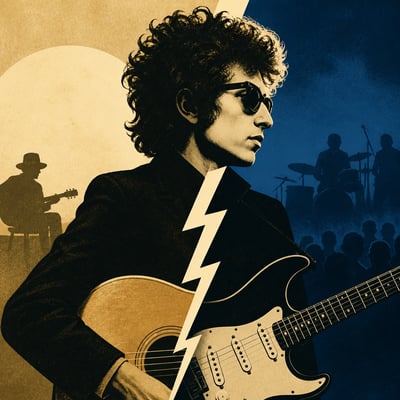
The topic centers on Bob Dylan’s Bringing It All Back Home, the 1965 album that paired electric rock instrumentation with acoustic songs and marked a decisive turn from his earlier folk presentation.
The album’s recording sessions, surreal and politically alert lyrics, and controversial reception—especially alongside Dylan’s later electric appearance at the Newport Folk Festival—remain central to accounts of his changing musical direction. Related material connects the album to Dylan’s Greenwich Village years, Another Side of Bob Dylan, Highway 61 Revisited, and later live performances of songs such as It’s Alright, Ma (I’m Only Bleeding).
The story is now framed more narrowly around Bringing It All Back Home itself rather than Dylan’s broader 1964–1965 transition. The update adds precise recording and album-structure details and extends discussion of the album’s later critical and live-performance reception.
The account remains substantively consistent, with only modest additions: Bob Johnston is newly named, and Newport’s divided response is described more explicitly as cheers and boos.
The current version adds more precise production chronology and recording details, but it does not materially alter the established interpretation of the album as Dylan’s folk-to-rock transition.
The story remains substantively unchanged, with the current version mainly reinforcing the album-to-Newport transition and its lyrical shift. D.A. Pennebaker is newly included as a relevant figure, but no major new development or change in interpretation appears.
The framing has tightened around three linked milestones in Dylan's 1965 shift: the album pivot, the breakout single, and the Newport electric set. The biggest change is a clearer, more sequential interpretation of how that transition unfolded and why it mattered in real time.
The story has broadened from mainly centered on Bringing It All Back Home to a fuller 1965 electric-era frame that gives Highway 61 Revisited equal weight. The new version also adds more specific personnel and songs, strengthening the sense of a staged, collaborative transition rather than a single album-centric pivot.
The cluster is primarily about Dylan's 1964-1965 artistic transition, with Bringing It All Back Home as the central hinge between acoustic folk and electric rock. Coverage consistently emphasizes the album's split-side structure, rapid Columbia sessions under Tom Wilson, the role of session musicians, and the immediate downstream effects in songwriting, charting, and live controversy at Newport. A smaller but related strand uses later essays and reviews to frame Dylan's broader evolution in lyric style, performance practice, and career-scale reinvention.