
 AI Governance
 Data Centers
 Drones
 Climate
 Privacy
 2026 Maine Senate
 Bob Dylan
Rolling Thunder Revue
Coverage from Flagging Down the Double E's, Yahoo, and others
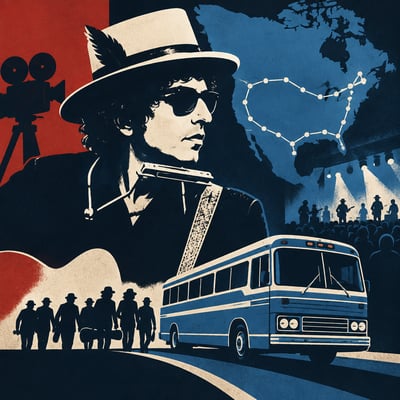
The Rolling Thunder Revue was Bob Dylan’s mid-1970s touring project, defined by its fluid ensemble, collaborative performances, and distinctive concert repertoire.
Joan Baez joined Dylan alongside musicians including Rob Stoner, Scarlet Rivera, Howie Wyeth, Mick Ronson, David Mansfield, Steven Soles, and T Bone Burnett. Its legacy is preserved through recordings from shows such as Fort Worth and Fort Collins, the Hard Rain-associated material, and archival releases including The Rolling Thunder Revue: The 1976 Live Recordings. Together, these performances and documents illuminate the Revue’s musical range and enduring place in Dylan’s concert history.
The archival project is now more concretely defined, adding a standalone complete Fort Worth edition, an advance track, and expanded Hard Rain-related documentation.
The story is modestly broadened by explicitly positioning the 1976 archive alongside an already released 1975 archival collection, creating a fuller two-leg record of the tour.
The story has shifted from general fiftieth-anniversary reassessment to a concrete, large-scale archival release documenting nearly the full professionally recorded 1976 second leg.
- A 39-CD Rolling Thunder archive is scheduled for November 6, 2026.
- The set contains 371 unreleased performances across 381 tracks.
- The archive covers nearly the full professionally recorded 1976 second leg.
- A separate three-LP edition presents the complete May 16 Fort Worth concert.
- No official or verified audience recording has been located for Salt Lake City.
The reassessment is largely confirmatory, but it adds sharper detail about the 1976 leg's revised repertoire and identifies Hard Rain as a selective composite rather than a complete tour document.
Bob Dylan’s 1975–76 Rolling Thunder Revue is receiving a dense anniversary and archival reassessment, with attention to its ensemble touring model, changing setlists, preserved recordings, documentary mediation, and surviving archive gaps.