
 AI Governance
 Data Centers
 Drones
 Climate
 Privacy
 2026 Maine Senate
 Bob Dylan
Bob Dylan’s “Murder Most Foul”
Coverage from RTÉ Brainstorm, Untold Dylan, and others
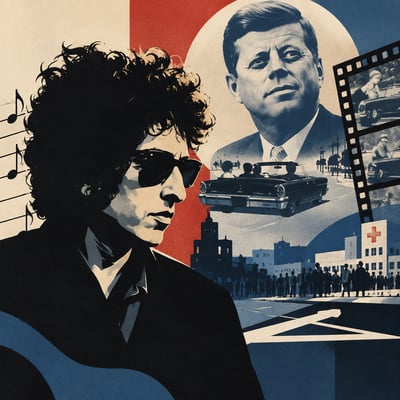
Released in 2020, Bob Dylan’s “Murder Most Foul” begins with the assassination of John F.
Kennedy in Dallas and expands into a long sequence of references to American songs, artists, historical figures, and cultural images. Critics and Dylan scholars have explored how its lyric collage connects the assassination with political violence, national trauma, and cultural memory, while emphasizing that the song is poetic interpretation rather than forensic reporting. Its pandemic-era release and performances have also shaped discussion of how listeners encounter the song as a reflection on history and American life.
If you read one thing
It offers a clear, well-supported introduction to the song’s long-form design and its framing of the assassination as unresolved national trauma.
Best explainer
It broadens the introduction by connecting the song’s cultural allusions to its form and place in Dylan’s late-career work.
The evidence
Its close reading adds a distinct account of how the song links the assassination to systemic violence, racism, and enduring national trauma.
The evidence
It contributes a focused reading of the song’s folk-ballad and cinematic references as part of its cultural-memory collage.
Unresolved national trauma
Commentary reads the Kennedy assassination as an enduring American trauma rather than a closed event. The song’s circular form and emphasis on collective responsibility make historical memory a question of unresolved national failure.
Cultural memory through allusion
The song is interpreted as a collage of musical, literary, and cinematic references that places the assassination within a wider cultural memory. Its recurring historical anchor connects shifting impressions without turning them into straightforward chronology.
Long-form late-career epic
The song’s extended, nonconventional form remains central to commentary on its effect: it accumulates voices and images rather than following a standard song structure. Writers situate that design within Dylan’s late-career work and the broader shape of Rough and Rowdy Ways.
Critique of systemic violence and power
A substantial interpretive strand treats the assassination as an entry point for criticizing wider American patterns of violence, racism, political distrust, and concentrated power. These readings make the song’s historical imagery a vehicle for social critique as well as elegy.
11 members
size of Dylan’s backing band
“After visiting Diamond’s Las Vegas show, Dylan adopted a large-scale revue style with loose-fitting shirts, an 11-piece backing band, three backing singers, and makeup. He also hired Diamond’s manager, Jerry Weintraub.”
three singers
number of backing singers
“After visiting Diamond’s Las Vegas show, Dylan adopted a large-scale revue style with loose-fitting shirts, an 11-piece backing band, three backing singers, and makeup. He also hired Diamond’s manager, Jerry Weintraub.”
17-minute minutes
duration of the song’s narrative
“The song ends with one final request to Wolfman Jack: “play Murder Most Foul.” This creates an infinite loop. The song begins with the assassination, moves through its 17-minute narrative and returns to the request that starts it again.”
160 lines
total song lines
“Lee Harvey Oswald receives only two of the song’s 160 lines, and Dylan suggests that the so-called assassin did not act alone.”
two lines
number of lines given to Lee Harvey Oswald
“Lee Harvey Oswald receives only two of the song’s 160 lines, and Dylan suggests that the so-called assassin did not act alone.”
Recent articles add specific musical and literary readings, but reinforce existing interpretations of the song as a collage of cultural references anchored by the Kennedy assassination; they do not establish a material change in the Topic.
Previously
Bob Dylan's "Murder Most Foul" remains a sustained subject of analysis as a nearly 17-minute meditation on the Kennedy assassination, American cultural memory, political violence, and the traditions of popular music. Later commentary connects its sparse, extended form and dense allusions to Rough and Rowdy Ways, Dylan's late-career songwriting, and earlier works such as "Desolation Row."
Recent analysis adds a more specific debate over whether the song offers consolation or leaves its subject unresolved, while reinforcing the existing view of it as a layered cultural meditation.
 Dylagence / Pamela Brown
 Just Poems
 conradbrunstrom.wordpress.com / conrad brunstrom