
 AI Governance
 Data Centers
 Drones
 Climate
 Privacy
 2026 Maine Senate
 Bob Dylan
Dylan’s Gospel Period
Coverage from Dollar Bin, Quillette, and others
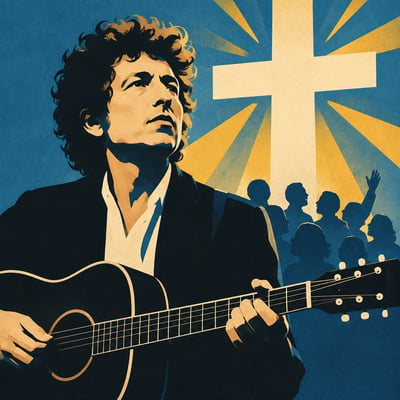
Bob Dylan’s gospel period began with his evangelical Christian conversion and produced a concentrated body of songs and albums, including Slow Train Coming, Saved, and Shot of Love.
Songs such as “Gotta Serve Somebody,” “When He Returns,” and “I Believe in You” brought explicit religious conviction into his writing and performances, while the 1979–1981 touring band and demanding concert repertory made the period a major artistic and cultural departure. Later releases and documentaries, especially Trouble No More, have revisited its recordings, live energy, spiritual intensity, and divided reception.
If you read one thing
It offers a clear introduction to the period's musical achievement while framing the central disagreement over Dylan's religious meaning.
The counter-case
It presents the contrasting view of the period as a sustained evangelical intervention with distinctive recordings and live performances.
Best explainer
It adds focused insight into the flexible rehearsals, changing lineups, and improvisation that shaped Dylan's gospel touring band.
The evidence
It broadens the musical discussion from Slow Train Coming to the full trilogy and documents its continuing critical rehabilitation.
Critical rehabilitation of the gospel trilogy
Recent commentary increasingly treats Slow Train Coming, Saved, and Shot of Love as artistically consequential despite unevenness, controversial religious messaging, and historical fan resistance. The period is being reassessed as a substantial creative phase rather than a failed detour.
Slow Train Coming's musical achievement
Slow Train Coming is repeatedly defended on musical grounds: its Muscle Shoals-linked production, gospel-rock arrangements, high-profile collaborators, and strong performances are treated as central to its significance. In these readings, the album's musical force partly exceeds or complicates its overt theological program.
Flexible, high-variation live performance
The gospel tours are defined in the corpus as a demanding but unusually adaptable performance system, with loose rehearsals, changing lineups, improvisation, and nightly differences in vocals, lyrics, and instrumental interplay. This live flexibility is a major part of the period's artistic identity.
Competing interpretations of religious meaning
The period remains interpretively divided between readings that emphasize evangelical conviction and apocalyptic Christian language, and those that place greater weight on Dylan's Jewish background, broader religious-poetic concerns, or musical experimentation. Later comments and criticism continue to complicate a simple born-again account.
Contested Issue
Should Dylan's late-1970s and early-1980s gospel period be understood primarily as an evangelical Christian statement or as a more complex meditation on belief, religious traditions, and poetic themes?
Some articles interpret the period as a sustained evangelical vision that reshaped Dylan's songs, performances, and public language. Others argue that the albums cannot be reduced to straightforward born-again testimony and instead combine Christian exploration with Jewish background, broader religious ideas, and musical or poetic concerns.
Sustained evangelical vision
The gospel period expressed a durable Christian commitment and evangelical worldview that substantially shaped Dylan's recordings, performances, stage language, and songwriting.
Complex religious and poetic exploration
The period should not be read as simple born-again testimony; its songs represent a more layered exploration of belief shaped by Jewish background, Christian traditions, philosophy, poetry, and musical form.
No material change is evident because no new Topic members were supplied; the Topic remains an ongoing retrospective reassessment of Bob Dylan’s late-1970s and early-1980s gospel period.
Previously
Bob Dylan's 1978–1981 gospel period is receiving sustained retrospective attention. Recent criticism and archival work connect Slow Train Coming, Saved, Shot of Love, the gospel tours, and collaborators such as Jerry Wexler, Mark Knopfler, and Fred Tackett, while reassessing the era's initial backlash and lasting musical value.
 Mitch Bogen's Art & Argument / Mitch Bogen