
 AI Governance
 Data Centers
 Drones
 Climate
 Privacy
 2026 Maine Senate
 Bob Dylan
“Blowin’ in the Wind”
Coverage from AOL.com, Cult Following, and others
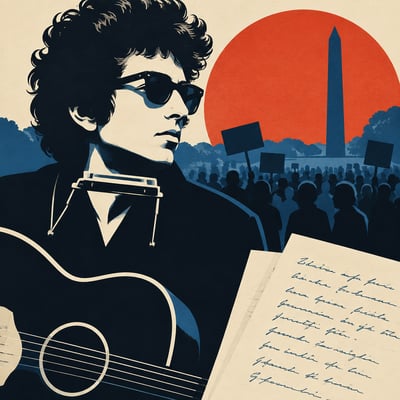
Written in 1962 and released on The Freewheelin’ Bob Dylan in 1963, “Blowin’ in the Wind” became one of Dylan’s best-known songs.
Peter, Paul and Mary’s recording brought it to a broad audience, and the trio performed it at the March on Washington; the song is also associated with a performance at the Lincoln Memorial before Martin Luther King Jr.’s “I Have a Dream” speech. Its questions have supported varied interpretations, while recordings by many artists and the market for song-related material—including handwritten lyrics and the Ionic Original auction episode—form part of its continuing cultural and collectible history.
If you read one thing
It provides the clearest broad introduction to the song’s rapid composition, folk-derived influences, civil-rights impact, and contested protest-song identity.
Best explainer
It reconstructs the Greenwich Village origins and shows how managers, labels, and interpreters helped turn the song into a cultural landmark.
The evidence
It demonstrates how Peter, Paul and Mary’s commercially successful cover carried the song from Dylan’s recording into civil-rights-era popular culture.
The evidence
It explains the Ionic Original’s scarcity and price as a revealing tension between collectible ownership and the song’s democratic cultural history.
Cover-driven cultural legacy
The song’s historical importance is defined less by Dylan’s original commercial recording than by its circulation through successful covers and later reinterpretations. Those versions connected it to civil-rights culture, protest movements, and audiences well beyond the early New York folk scene.
Folk-derived authorship and interpretive tension
The song remains understood through a combination of folk-process influences, rhetorical openness, and Dylan’s distinctive authorship. Its persistent identification as a protest or civil-rights anthem coexists with accounts of Dylan resisting a fixed protest-singer identity and with continuing debate over sources and intent.
Scarcity-driven collectible market
The 2021–2022 re-recording has made the song a test case for treating recorded music as a singular luxury artifact rather than a broadly accessible release. The Ionic Original combines high-fidelity positioning, auction scarcity, and unresolved questions about ownership, access, and the economics of digital-era music distribution.
Layered and partly contested archive
The song’s historical record is expanding through early tapes, demos, performance accounts, and renewed reconstruction of its Greenwich Village origins. These materials deepen the story but also preserve uncertainty around chronology, provenance, melodic sources, and the boundary between documented history and Dylan-era mythmaking.
There is no material change from the prior state: no new topic members or claims provide evidence of a substantive development.
Previously
Bob Dylan's Blowin' in the Wind dominates current attention through a late-career re-recording and collectible Ionic Original release, while archival material revisits its 1962 Greenwich Village origins, folk sources, cover history, and civil-rights legacy.