
 AI Governance
 Data Centers
 Drones
 Climate
 Privacy
 2026 Maine Senate
 Bob Dylan

Bob Dylan’s Gospel Years
Coverage from Dollar Bin, Quillette, and others
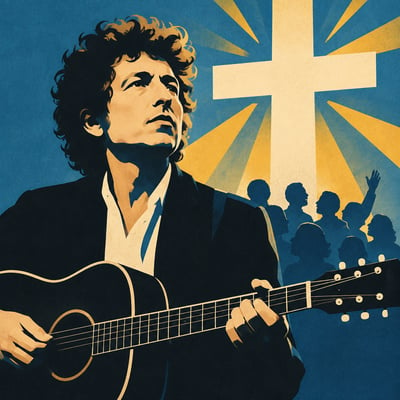
Bob Dylan’s gospel years center on the Christian songs and performances associated with Slow Train Coming, Saved, and Shot of Love.
Songs including “Gotta Serve Somebody,” “When He Returns,” and “I Believe in You” invite close attention to their lyrics, music, and spiritual outlook, while the 1979–1981 touring band brought this material to the stage. The period also has a substantial afterlife in books and archival works such as Trouble No More, which revisit the concerts and recordings alongside questions of artistic expression and audience reception.
If you read one thing
Its broad framing introduces the gospel period as both a religious turn and a consequential, controversial artistic phase.
The evidence
It offers a nuanced reading of Slow Train Coming that connects its musical achievement with competing interpretations of Dylan’s religious meaning.
Best explainer
It directly explains the case for reassessing the trilogy’s artistic and emotional significance despite its controversial reception.
The evidence
Fred Tackett’s account adds firsthand detail about the touring band’s demanding, flexible, improvisational approach.
Critical rehabilitation of the gospel trilogy
Commentary treats Slow Train Coming, Saved, and Shot of Love as artistically consequential despite unevenness, controversial religious messaging, and audience resistance. The period is often reconsidered as a substantial creative phase rather than a failed detour.
Slow Train Coming's musical achievement
Multiple readings defend Slow Train Coming for its production, gospel-rock arrangements, collaborations, and performances. Its musical force is often treated as distinct from—and sometimes more persuasive than—its overt theological program.
Flexible, high-variation live performance
Retrospective accounts describe the gospel tours as demanding but musically adaptable, with loose rehearsal practices, changing band dynamics, improvisation, and nightly variation. That live approach is presented as a defining part of the period's artistic identity.
Competing interpretations of religious meaning
Interpretations differ on whether the songs are best understood as direct evangelical testimony or as a more complex engagement shaped by Dylan's background, musical traditions, and poetic concerns. Later comments, including Dylan's own, complicate a straightforward born-again reading.
No new Topic members were supplied, so no material change in Bob Dylan’s gospel-period reassessment is evident.
Previously
Bob Dylan's 1978–1981 gospel period is receiving sustained retrospective attention. Recent criticism and archival work connect Slow Train Coming, Saved, Shot of Love, the gospel tours, and collaborators such as Jerry Wexler, Mark Knopfler, and Fred Tackett, while reassessing the era's initial backlash and lasting musical value.
 Mitch Bogen's Art & Argument / Mitch Bogen