
 AI Governance
 Data Centers
 Drones
 Climate
 Privacy
 2026 Maine Senate
 Bob Dylan
Bob Dylan Center
Coverage from Flagging Down The Double E's, Our Reality Show, and others
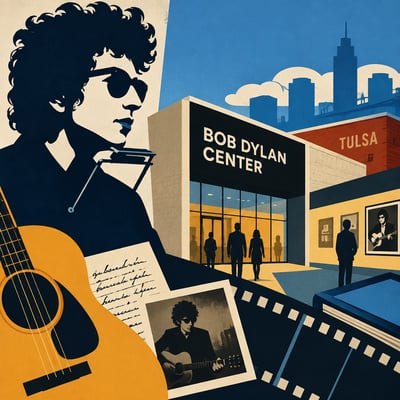
The Bob Dylan Center in Tulsa is an archive and cultural institution devoted to preserving and interpreting Bob Dylan’s creative life and work.
Its activities connect archival materials with exhibitions, films, educational programming, fellowships, and public events, presenting music, writing, performance, and related cultural history through works such as Blonde on Blonde, Blood on the Tracks, and Rough and Rowdy Ways. Situated in Tulsa’s arts landscape alongside the Woody Guthrie Center and venues such as Cain’s Ballroom, the Center serves as both a research resource and a public destination.
If you read one thing
It provides the broadest introduction to how the Center presents Dylan’s creative process through archival drafts and multimedia exhibitions.
Best explainer
It explains the Center’s institutional development, public engagement, major exhibitions, and resource constraints.
The evidence
It supplies concrete evidence of the archive extending beyond preservation into structured development of emerging songwriters.
Archival access extending into songwriter development
The Center is using the Bob Dylan Archive as a platform for emerging-artist development through a recurring songwriter fellowship. The program combines archival study with Tulsa residency, recording resources, mentorship, and publishing-industry connections, extending the institution beyond museum and research functions.
Private materials are being consolidated into a managed public archive
The institution depends on stewardship that brings dispersed manuscripts, recordings, correspondence, and ephemera into an organized public and scholarly resource. Coverage presents archival leadership, collectors, and donors as central to expanding and authenticating what Tulsa can preserve and interpret.
The new article reinforces the Center’s existing presentation of Dylan’s creative process through archival materials but provides no material new development.
Previously
Bob Dylan's Tulsa archive now functions as a public museum and research resource, using drafts, notebooks, recordings, and interactive exhibits to document songwriting while collectors and curators expand access.