
 AI Governance
 Data Centers
 Drones
 Climate
 Privacy
 Bob Dylan

Blood on the Tracks
Coverage from Mojo, Uncut, and others
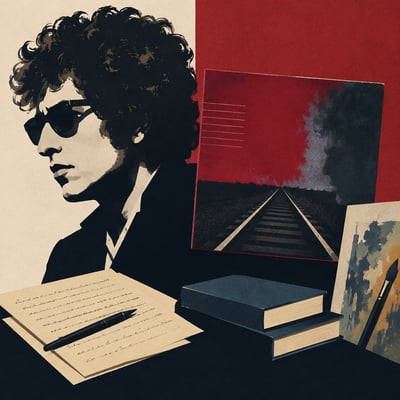
Released in 1975, Blood on the Tracks is one of Bob Dylan’s most closely examined albums, with songs including “Tangled Up in Blue” and “Idiot Wind” often interpreted through the breakdown of his marriage to Sara Lownds.
Dylan also described literary influences, including Anton Chekhov, while accounts of painter Norman Raeben’s teaching connect the album’s distinctive shifts in time and point of view to new approaches to narration. Its creation involved New York recording sessions followed by Minnesota re-recordings of five songs. The interplay of intimate subject matter, fictional possibility, and deliberate musical revision helps explain the album’s lasting reputation.
If you read one thing
This broad, clear account introduces the album’s personal, literary, and narrative dimensions.
The evidence
Its account of the New York and Minneapolis sessions explains how recording and collaboration shaped the album’s competing versions.
The evidence
Newly surfaced song drafts provide concrete evidence of lyric revision and complicate straightforward autobiographical readings.
Best explainer
Its focused reading of “Tangled Up in Blue” illustrates how nonlinear perspective transforms personal material into constructed narrative.
Recording revision and competing versions
The album’s identity is tied to its movement from the New York sessions to later Minneapolis re-recordings, as well as Dylan’s continued reshaping of songs. Newly reported manuscripts add evidence of lyric revision, including material omitted from the released versions.
Personal experience versus constructed narrative
Personal relationships remain part of how the songs are interpreted, but accounts also emphasize nonlinear perspective and deliberate transformation rather than a straightforward autobiographical record. Claims about the personal inspiration for individual songs add context without settling the album-wide interpretation.
“Tangled Up in Blue” as an interpretive center
“Tangled Up in Blue” remains a key lens on the album’s changing perspectives and nonlinear storytelling. Discussion of its phrasing, harmony, and changing versions presents the song as a work Dylan continually rethought rather than a fixed statement.
Enduring canonical status
Retrospective coverage continues to present Blood on the Tracks as a landmark in Dylan’s work and a benchmark for emotionally direct, narratively ambitious songwriting. Its importance is treated as established rather than as a newly emerging judgment.
three
surviving Blood on the Tracks notebooks examined by Jeff Gold
“Music historian and archivist Jeff Gold, who appraised the complete Bob Dylan Archive and examined Dylan’s three surviving Blood on the Tracks notebooks, said he had not previously encountered a contemporaneous lyric manuscript from the album in private hands or on the market outside those notebooks.”
New discussion revisits “Idiot Wind” and the Minnesota musicians’ limited credits, reinforcing existing interpretations and session-history debates without materially changing the Topic.
Previously
Bob Dylan's Blood on the Tracks is being reassessed through newly surfaced drafts, session archives, competing New York and Minneapolis recordings, and close study of Tangled Up in Blue. The strongest signal treats the album as an evolving recording project rather than a fixed 1975 artifact, while debate continues over biography, literary construction, and which session best captures its songs.
The additional coverage reinforces the existing retrospective focus; it does not materially change the story’s interpretation or significance.
The main new detail is that a 2026 auctioned manuscript preserves working lyrics for two songs, including an omitted verse. Otherwise, the current coverage largely reinforces the existing retrospective account.
 Christian's Music Musings