
 AI Governance
 Data Centers
 Drones
 Climate
 Privacy
 Bob Dylan

Mother Of Muses Interpretive Studies
Coverage from bob-dylan, Wikipedia, and others
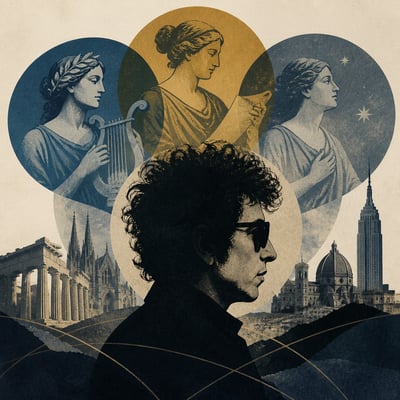
Recent Dylan commentary examines "Mother of Muses" as a dense reuse of Greek myth, Homeric invocation, and muse imagery.
A related strand treats anachronism and mixed historical references as recurring compositional features, while one older reference supplies recording and live-performance context for "Bob Dylan's 115th Dream."
The framing of "Mother of Muses" has broadened from a focused debate over Erato versus Mnemosyne into a more explicitly classical reading centered on Homeric invocation, muse traditions, and mythic recombination. A secondary strand has also emerged around "Bob Dylan's 115th Dream," adding recording-session and delayed-performance context that was not part of the earlier story.
The interpretation remains substantively unchanged, with current coverage reinforcing the Erato-focused reading and Dylan’s use of anachronistic historical associations.
The framing shifts from a general muse-and-history interpretation to a more specific claim that "Mother of Muses" is centered on Erato and song inspiration. The current version also sharpens the Dylan-context angle by tying the song more explicitly to his broader statements about songs arriving from elsewhere and to his late-style use of historical collage.
The framing shifts slightly from a specific debate over competing classical references to a broader, cleaner interpretation of "Mother of Muses" as a song about inspiration and Dylan's time-blending style. The current version deemphasizes the Erato/Mnemosyne dispute and presents the anachronism-and-symbolism reading as the main throughline.
The material centers on competing and overlapping readings of Bob Dylan's "Mother of Muses," especially whether the song invokes Erato, Mnemosyne, or a broader tradition of muse-centered inspiration. A second strong strand treats the song as part of Dylan's late-career habit of collapsing historical periods and linking figures across time. Together, the pieces frame the song as a dense literary and historical construction rather than a straightforward lyric.