
 AI Governance
 Data Centers
 Drones
 Climate
 Privacy
 2026 Maine Senate
 Bob Dylan

World Cup Drone Enforcement
Coverage from New York Times, 6ABC Philadelphia, and others
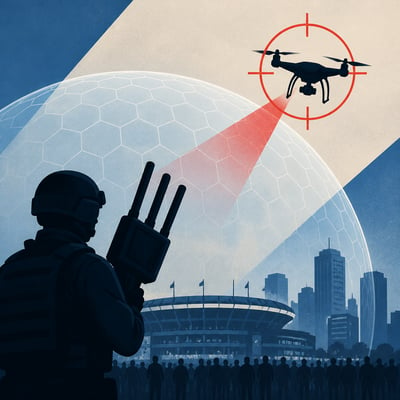
Authorities are tightening drone restrictions around World Cup venues and related major events, with the FBI, FAA, and local police seizing unauthorized aircraft, issuing citations, and warning of criminal penalties.
The enforcement push is aimed at protecting stadiums, fan zones, and nearby communities from both careless violations and potential weaponized drone use. A separate White House event plot involving alleged explosive drones reinforces why counter-drone security is being treated as a live public-safety issue.
The story has shifted from a broad Kansas City public-safety and privacy narrative to a narrower enforcement story centered on FAA restrictions and federal prosecutions around World Cup venues. Dallas has emerged as the main hotspot, with seizures and criminal charges showing the rules are being actively enforced.
- FAA restrictions now cover multiple U.S. World Cup host sites.
- Dallas Stadium is the main enforcement hotspot.
- More than 70 drones were reportedly seized in Dallas.
- Federal prosecutors have filed charges against operators.
- Operators need FAA approval, waivers, or certification to fly legally.
The story has shifted from a general FAA restriction/authorization framework to an active Kansas City security operation where drones are being used operationally while counter-drone enforcement is already catching violations. It also adds a new privacy and national-security dimension around DJI equipment in sensitive public-safety use.
- Kansas City police and fire departments are actively using drones for World Cup operations.
- Unauthorized drone incursions are already being intercepted around event venues.
- DJI drones used by KCPD are drawing privacy and national-security scrutiny.
- Federal Air Marshal Service is issuing violation notices to operators.
- Multiple federal agencies are directly involved in airspace protection.
The story has shifted from an FBI counterterrorism case to a broad FAA regulatory action ahead of the 2026 World Cup. The new emphasis is on temporary drone restrictions, enforcement, and a formal approval pathway for legitimate operations inside restricted airspace.
- FAA imposed temporary drone restrictions around World Cup 2026 sites.
- DHS authorization can permit some operations inside restricted airspace.
- DETER enforcement is used for faster drone-violation response.
- Commercial operators now face approval requirements for restricted zones.
- A Chattanooga drone show required FAA waiver approval.
The update sharpens the operational picture: the alleged plot is now described as a more complex, multi-stage attack involving sniper fire and a follow-on assault, and investigators are said to have relied heavily on encrypted Signal evidence and a suspect phone. It also reframes the case as a broader warning about the limits of airspace restrictions and the need for expanded counter-drone planning.
The story shifted from routine drone enforcement at sports venues to a far more serious alleged terror plot involving drones as weapons against a White House event. That materially raises the stakes, introduces new suspects and agencies, and reframes drones from nuisance violations to part of a mass-casualty attack plan.
The story has expanded from broad FAA-led drone restrictions into a more specific multi-agency enforcement operation, with the FBI and TSA now explicitly involved and multiple named defendants tied to separate host cities. The current version also reframes the issue as routine unauthorized flights being actively tracked and punished, rather than just general airspace restrictions.
- FBI and TSA are now explicitly involved in World Cup drone enforcement.
- Named defendants appear in Houston, Atlanta, and Dallas cases.
- Authorities report seizures, citations, and charges across multiple host cities.
- Officials say most incidents are routine unauthorized flights, not attack plots.
The story has shifted from describing restrictive drone rules with authorization carve-outs to showing those rules being actively enforced through seizures and criminal charges. Federal authorities are now treating intrusions into World Cup airspace as an operational security threat with real penalties, not just a regulatory constraint.
- Federal authorities are seizing drones around World Cup venues.
- Several operators have been charged for restricted-airspace flights.
- Officials warn violations can trigger criminal prosecution and major penalties.
The story has shifted from a specific FBI counterterrorism case to a broad FAA regulatory crackdown on drone use around the 2026 FIFA World Cup. The new emphasis is on formal no-drone zones, authorization pathways, and how these restrictions are affecting legitimate operators and local events.
- FAA imposed temporary flight restrictions around FIFA World Cup 2026 sites.
- Some drone flights can proceed only with DHS authorization.
- DETER initiative and federal mitigation tools will help enforce violations.
- Chattanooga drone show received a waiver after a no-fly-zone conflict.
- Commercial Drone Alliance is raising concerns about operational impacts.
The story has shifted from general counter-drone enforcement around major events to a specific FBI-disrupted alleged attack plot against a White House UFC event. The new version adds arrests, named suspects, and evidence details, making the threat more concrete and high-stakes.
- Five suspects were reportedly arrested in the White House UFC plot.
- Investigators cited encrypted Signal chats as evidence.
- The case reportedly spans multiple states and at least a dozen FBI field offices.
- Tycen Proper is named as a suspect in current reporting.
- Reporting now raises counter-UAS funding and civil-liberties concerns.
The story is now framed less as a general World Cup counter-drone enforcement push and more as an active public-safety threat issue, with explicit concern that some drones could be weaponized. The added White House event plot strengthens the urgency and broadens the security context beyond stadium violations.
The story has shifted from broad preparation to active enforcement: authorities are now making seizures, issuing citations, and making arrests around World Cup venues. It also adds clearer evidence that local participation is expanding through FBI training, grants, and new legal authority.
The story has broadened from World Cup airspace enforcement into a wider counter-drone public-safety program, with prisons and other sensitive sites now featured more explicitly. The current version also adds stronger emphasis on layered interception systems and on gaps in detection and governance, not just enforcement actions.
The story shifts from broad counter-drone preparedness around World Cup venues to explicit, active enforcement, with federal and local agencies now using flight restrictions, approved systems, and penalties in real time. The framing also tightens around public-event security as the primary driver, while prisons remain a secondary use case.
The story now emphasizes that counter-drone measures are moving from event-specific enforcement into a broader operational model for local policing and corrections, backed by more formal training and authority. It also adds more explicit evidence of expanded local capability through federal/state frameworks, grants, and appropriations.
The story broadens from World Cup-focused drone enforcement into a wider counter-drone security framework, with DHS now explicitly included and the threat framed more aggressively as terrorism, sabotage, and covert attack risk. It also adds more evidence of implementation, especially around correctional-facility surveillance and local use of approved counter-UAS systems under the Safer Skies Act.
- DHS is now explicitly part of coordinated counter-drone deployments.
- Drone threats are now framed as terrorism and sabotage risks.
- Safer Skies Act procedures are described as enabling approved local counter-UAS use.
- AI-assisted surveillance pilots are appearing in correctional facilities.
- Reporting now emphasizes immediate deployment and training over speculation.
The story now emphasizes that World Cup drone security has moved from planning and warnings into active enforcement, backed by federal-led restrictions and new legal authority for local counter-UAS action. It also broadens from event security to a wider public-safety and procurement push for counter-drone systems.
- Reported drone seizures, citations, arrests, and penalties are now underway.
- The Safer Skies Act is expanding local counter-drone authority.
- Federal grants are helping fund local counter-drone procurement.
- Counter-drone tactics now include active disablement and seizure operations.
- The story now includes prisons and other non-World Cup public-safety settings.
The story broadens from World Cup-focused counter-drone deployment into a more operational enforcement and broader municipal surveillance picture. It now emphasizes active seizures and penalties, plus added roles for state police and a clearer implementation of local counter-UAS authority.
- Unauthorized flights are now resulting in seizures, fines, and criminal warnings.
- State police agencies are newly part of the coordination picture.
- The Safer Skies Act expands approved local counter-drone authority.
- Municipal drones are being used for routine monitoring and first-response work.
- Corrections agencies are piloting continuous aerial surveillance for contraband detection.
The story has shifted from general World Cup counter-drone tightening to more explicitly operational enforcement around a wider set of venues, with federal funding and local training now translating into active no-drone zones and electronic disablement capability. At the same time, the narrative more clearly shows drone adoption on the public-safety side, not just anti-drone controls.
The story has broadened from World Cup-specific drone security to a more institutionalized public-safety model, with FBI-led training and expanded legal authority enabling local agencies to field counter-UAS capabilities more routinely. It also adds a new emphasis on operational limits, highlighting that detection and legal authority gaps still constrain what agencies can do.
The story now extends beyond basic no-drone restrictions into a more operational counter-UAS regime, with layered detection/interdiction tools and explicit legislative backing for local participation. It also adds routine public-safety drone use as a parallel thread, especially first-responder deployments.
- Safer Skies Act expands state and local counter-UAS participation.
- Counter-UAS tools now include net capture and controlled landings.
- Kansas City highlighted for drone-as-first-responder programs.
- Police leaders in Dallas, Arlington, and New York now named.
- Foreign-made hardware and privacy concerns now surface.
The story has broadened from a general crackdown around World Cup venues to a more explicit, city-specific operational picture, with more host cities now named and federal enforcement language made sharper. It also adds clearer evidence that local police drone use is becoming a standard part of tournament security, not just a supporting capability.
- DETER and FAA advisories are now explicit enforcement tools.
- Warnings include heavy fines, criminal charges, confiscation, and jail time.
- Additional host-city security nodes are identified: Dallas-Fort Worth, Arlington, Los Angeles, and Boston.
- Police drones are being used for patrol support and scene documentation.
- City counter-UAS programs now include operator identification capabilities.
The story now centers more specifically on formal FAA restrictions and FBI-led enforcement around World Cup venues, while the bigger change is the broader move to authorized local counter-UAS participation under the Safer Skies Act. That shifts the narrative from general tightening to a more structured public-safety operating model.
The story has shifted from general counter-drone preparedness to a more concrete, regulated rollout around FIFA World Cup 2026 venues, with explicit no-drone zones and coordinated federal-local enforcement. It also broadens the operational picture by showing police departments and correctional facilities moving from awareness to actual procurement and training.
- New no-drone zones are being created around World Cup venues.
- FAA, FBI, DHS, and DOJ are sharing counter-UAS responsibilities.
- NYPD and Philadelphia Police are buying tools and training officers.
- Authorized counter-UAS action faces notification and certification requirements.
- Correctional facilities are still confronting contraband delivery and surveillance drones.
The story has broadened slightly from World Cup-focused counter-drone security to a more general public-safety framework, with prisons and local threat-preparedness now more explicitly part of the same operational picture. The framing also shifts toward implementation under newer authority, while emphasizing persistent legal and technical limits.
The story has sharpened from general counter-drone expansion into a more specific World Cup-driven federal-local security rollout, with new legal and funding support making local participation more concrete. It also newly emphasizes that some capabilities are still constrained by operational limits and remain in pilot or supervised use.
- FIFA World Cup is now the primary deployment driver.
- New legal and funding frameworks are enabling local participation.
- Local officers are being trained for host-venue counter-drone operations.
- AI-enabled tools remain largely in pilot or supervised deployment.
- Jamming and disabling drones remain legally restricted.
The story shifts from broad counter-drone preparedness to more concrete public-safety implementation, with new legal authority and named vendors shaping actual deployments. It also adds a stronger prison-surveillance angle, including AI-assisted monitoring pilots.
The story is now framed less as an emerging security response and more as a formalized public-safety regime: federal approval and notification rules are becoming central, while local agencies are adding more structured layered defenses. A new correctional-security angle also appears more explicitly through AI-assisted aerial surveillance.
The story now puts more emphasis on actual deployment and legal authority, not just rising threat reports. It also broadens the operational picture by naming vendors and showing corrections pilots alongside major-event security.
The story now emphasizes that counter-drone efforts are moving from general public-safety planning into more concrete deployments shaped by federal approval and funding rules. It also adds a sharper warning that AI-enabled and autonomous drone features may outpace current detection and response capabilities.
The story now emphasizes that counter-drone efforts are moving from planning into concrete deployment, while also highlighting that current legal and technical limits still constrain what local agencies can do. It also sharpens the correctional-facility angle by framing drone use there as an active security problem, not just a niche application.
The cluster is centered on the expansion of counter-drone security measures around major public events and sensitive facilities, especially World Cup venues and large gatherings. The current signal shows local, state, and federal agencies adopting layered detection and mitigation systems, with new or expanded authority shaping deployments. A secondary but related thread is the use of drones in correctional surveillance and contraband detection, reinforcing the security-focus of the cluster.