
 AI Governance
 Data Centers
 Drones
 Climate
 Privacy
 2026 Maine Senate
 Bob Dylan
Drones Aid Response, Disrupt Firefighting
Coverage from KOTA, DroneXL, and others
U.
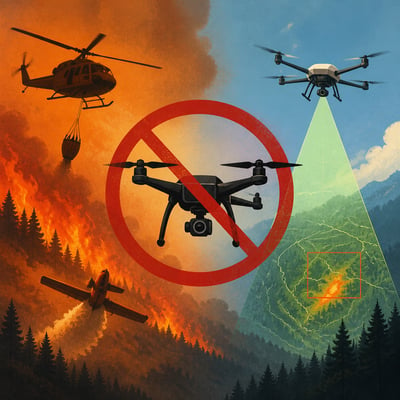
S. police and fire departments are expanding drone use for fireworks enforcement, wildfire monitoring, search-and-rescue, and other emergency operations. At the same time, unauthorized drones are forcing firefighting and law-enforcement aircraft to land, delaying wildfire response and prompting greater use of detection systems and criminal penalties. The pattern highlights both the operational value of drones for responders and the need for clearer rules, enforcement, privacy controls, and airspace coordination.
The story now puts more emphasis on concrete local enforcement results and a broader enforcement toolkit, not just general drone deployment and disruption. Sacramento's citation totals and California/Colorado interference cases make the operational and regulatory pressure more specific.
The story has shifted from broad drone use in emergency response to a more specific focus on holiday fireworks enforcement and concrete anti-drone tracking measures around wildfires. It also now emphasizes policy and privacy constraints as deployment expands.
- Drones are being used to identify illegal fireworks and trace launch sites.
- California agencies reported 184 drone incursions around the Eaton and Palisades fires.
- A firefighting aircraft collided with a consumer drone.
- Drone-detection tools can estimate aircraft and pilot location details.
- Some local policies now restrict facial recognition and immigration enforcement.
The story has shifted from general public-safety drone adoption to a sharper emphasis on wildfire airspace conflict and operational countermeasures. New reporting shows unauthorized drones repeatedly grounding firefighting aircraft while agencies simultaneously expand thermal support, AI detection, and funded DFR deployments.
- Unauthorized drones repeatedly grounded firefighting aircraft in the U.S. and British Columbia.
- New York launched a $75 million LETECH grant program.
- Santa Ana awarded a five-aircraft Drone as First Responder contract.
- California is testing AI camera detection, satellite monitoring, and infrared mapping.
- Privacy safeguards now include retention and public flight-log limits.
The story now centers more specifically on enforcement and operational testing: California agencies are using drones for fireworks citations and package-theft cases, while Cal Fire’s autonomous suppression efforts remain in trial stage rather than routine deployment. The legal and technical constraints also sharpen, with added emphasis on warrant requirements, privacy, and unresolved airspace approvals.
The story broadened from routine public-safety drone use to a wider operational phase that now includes autonomous wildfire ignition/suppression testing and coordination risks from unauthorized drones. It also adds a new Canadian wildfire-use case and a clearer emphasis on airspace management alongside privacy and warrant issues.
- British Columbia Wildfire Service is now a reported drone-ignition user.
- Wildfire drones are being tested for ignition and infrared monitoring, not just suppression.
- Unauthorized drones can ground manned aircraft near wildfires.
- Drone as First Responder programs are spreading across U.S. law enforcement.
- Airspace coordination is now a central constraint.
The story has broadened from wildfire-related drone interference and suppression to a wider public-sector drone expansion across enforcement, emergency response, and environmental monitoring. The biggest new angle is the policy and civil-liberties debate around routine drone use, including warrants, privacy, audits, and operational limits.
- California cities are using drones against illegal fireworks and property crime.
- Oregon agencies operate hundreds of public drones for multiple missions.
- Drone-as-first-responder programs are expanding during 911 calls.
- EFF and ACLU of Oregon are pressing privacy and oversight limits.
- Autonomous firefighting drones remain constrained by payload and range.
The core story is now framed more explicitly as a two-track wildfire issue: drones are not only disrupting firefighting aircraft, but also becoming a more visible operational tool for detection and suppression. The current version also adds specific recent enforcement and warning examples that sharpen the immediacy of the airspace-risk problem.
The story broadened from wildfire drone use plus unauthorized intrusions to a wider public-safety drone ecosystem, adding municipal policing and illegal fireworks enforcement as a notable new strand. At the same time, enforcement around restricted fire airspace appears more formal and visible, with citations and stronger warnings joining arrests.
The story has broadened from general wildfire drone use and disruption into more specific operational capabilities, especially AI-linked detection and suppression-oriented systems, alongside clearer enforcement escalation against unauthorized flights.
The story now places greater emphasis on active enforcement and real-world incidents, with a new arrest tied to drone interference during wildfire response. It also adds more concrete actors and examples of autonomous suppression concepts moving beyond monitoring into ignition and foam-based attack.
The story has broadened from general wildfire-drone conflict into more routine operational use by agencies, especially for mapping, hot-spot detection, prescribed-fire ignition, and early suppression. At the same time, enforcement against illegal drones is more explicit, with new references to tracing, fines, and criminal penalties.
- Routine infrared mapping and hot-spot detection are now central uses.
- Prescribed-fire drone ignition is a newly highlighted operational workflow.
- Autonomous suppression concepts are moving toward testing and deployment.
- Enforcement now includes operator tracing, fines, and criminal penalties.
- The story now includes Alaska and Montana wildfire operations.
The story is no longer just about drone-caused wildfire disruptions; it now more clearly includes a parallel push toward operational drone use for wildfire detection, monitoring, and suppression. The current version also broadens the set of actors and incidents, especially in California and the vendor ecosystem.
Unauthorized drones are repeatedly interfering with wildfire operations, forcing temporary groundings of helicopters and fixed-wing aircraft during active fires. Officials are emphasizing the safety risk to pilots, crews, and people on the ground, while also expanding detection, tracking, and legal enforcement. At the same time, drone technology is being developed for legitimate wildfire detection and suppression, highlighting a sharp divide between helpful and hazardous drone use in fire zones.