
 AI Governance
 Data Centers
 Drones
 Climate
 Privacy
 2026 Maine Senate
 Bob Dylan

Whisker-Guided Drone Navigation
Coverage from New Atlas, WIRED, and others
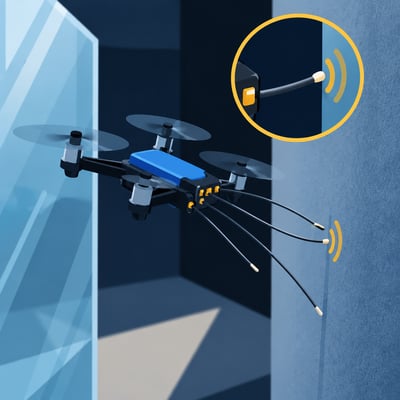
Delft University of Technology researchers developed a tactile navigation system that equips small drones with flexible artificial whiskers and pressure sensors.
By interpreting contact and filtering interference from propeller airflow, the onboard system can help a drone follow walls, avoid obstacles, map enclosed spaces, and find an exit by touch. Tests include dark rooms and transparent barriers—settings where visual sensors may struggle. The work explores how a lightweight contact-sensing system can extend drone navigation in confined, low-visibility environments, while remaining distinct from camera- or LiDAR-based navigation.
If you read one thing
WIRED clearly explains how whisker sensing, signal correction, and dark-room navigation fit together, while reporting key test results and limitations.
The evidence
The original research provides primary evidence on millimeter-scale sensing, the 44.1-gram test drone, and its onboard navigation hardware.
The evidence
It adds concrete test results on drift compensation, transparent-wall navigation, and whisker mounting that complement the overview and research article.
Tactile sensing fits microdrone constraints
The whisker system has been demonstrated on drones weighing under 100 grams, with millimeter-scale contact estimates and lightweight onboard processing. This establishes experimental feasibility within the payload and computing limits of small robots.
Touch enables navigation in visually obstructed spaces
Experiments demonstrate surface following, tactile mapping, and exit finding in darkness, alongside navigation around transparent barriers. These broaden the demonstrated capabilities, but the evidence remains experimental rather than establishing deployment beyond controlled settings.
Reliable touch depends on signal compensation
Propeller airflow, vibration, and sensor drift can distort contact readings, making filtering and drift compensation central to the system. Reported tests show reduced false detections, while broader operational reliability and device-specific calibration remain constraints.
3.2 grams
sensing apparatus mass
“The 3.2-gram sensing apparatus estimates contact depth with millimeter-scale accuracy while minimizing destabilizing forces.”
44.1 grams
drone mass
“two flexible artificial whiskers mounted on a 44.1-gram Crazyflie 2.1 Brushless drone.”
millimeter-scale
contact-depth accuracy
“The 3.2-gram sensing apparatus estimates contact depth with millimeter-scale accuracy while minimizing destabilizing forces.”
34 kilobytes memory
onboard processing memory
“A real-time processing pipeline filters noise and distortion caused by propeller airflow, producing millimeter-precision depth estimates. It runs entirely onboard a microcontroller using 34 kilobytes of memory, without external computing or positioning systems.”
three sensors
pressure sensors per whisker
“The researchers mounted two artificial whiskers at the front of a small drone. Each whisker has three miniature pressure sensors at its base, allowing the drone to estimate the location and depth of contact in three dimensions.”
Controlled trials quantify tactile exit-finding performance
New test results put numbers on the laboratory demonstration: the drone found a 2.5-foot exit in a glass-walled room in 90% of trials, while drift correction and noise filtering reduced reported false-positive detections from about 38% to zero. These results clarify performance under controlled conditions, not readiness for use in less structured environments.
Previously
Delft University of Technology researchers demonstrated a whisker-based tactile sensing system that lets a microdrone follow surfaces and map confined spaces without relying on cameras or LiDAR. The results show a compact alternative for navigation when visual sensing is unreliable, but testing remains at the laboratory stage.
The update adds that the drone found exits in darkness and reports drift and per-device calibration as constraints. These details refine the lab results but do not change the research-stage picture.