
 AI Governance
 Data Centers
 Drones
 Climate
 Privacy
 2026 Maine Senate
 Bob Dylan

Ukraine Expands Deep-Strike Drone Campaign
Coverage from WTOP News, Kyiv Post, and others
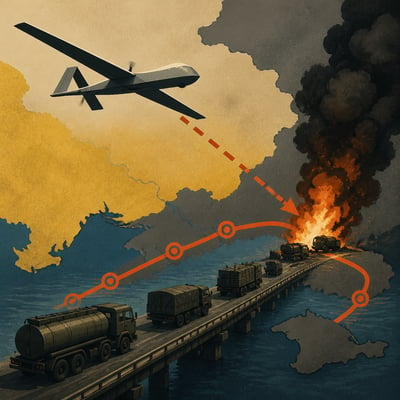
Ukraine is using domestically produced fixed-wing strike drones to attack Russian supply routes, bridges, fuel networks, ports, and industrial or logistics targets.
Mid-range systems are focused on the land corridor to Crimea and other occupied southern areas, while longer-range FP-1 drones have reached targets deep inside Russia. The campaign is intended to slow resupply, pressure Russian air defenses, and impose operational and economic costs, while Ukraine’s reported production growth and Russia’s countermeasures remain important uncertainties.
If you read one thing
It provides the clearest broad overview of how Ukrainian drones are pressuring logistics routes to Crimea.
Best explainer
It explains the operational methods and countermeasure contest shaping the effectiveness of Ukraine’s mid-range drone campaign.
The evidence
It adds the strongest quantified reporting on Fire Point’s production growth and its contribution to Ukraine’s strike capacity.
Latest development
It extends the picture beyond Crimea by showing the campaign’s continuing reach against targets deep inside Russia.
Sustained pressure on Crimea’s logistics network
Ukrainian mid-range drones continue targeting bridges, roads, fuel flows, ferries, maritime traffic, and other chokepoints linking occupied southern Ukraine with Crimea. Reporting describes traffic restrictions and fuel-related measures, but the scale and persistence of the operational effects remain difficult to verify independently.
Ukraine is extending strike effects deep inside Russia
Long-range Ukrainian drones, including FP-1 systems, are being used against Russian logistics, energy, industrial, and military targets far beyond the front, including locations near Moscow. This expands the geographic burden on Russian defenses and exposes rear-area infrastructure to recurring attacks.
Domestic production is becoming a central source of strike capacity
Fire Point and other Ukrainian producers are portrayed as expanding output, reducing assembly times, and supporting more frequent long-range operations. Production and capability figures remain largely company- or Ukrainian-government supplied, leaving the precise scale of the expansion uncertain.
Strike effectiveness is shaped by an adaptation contest
Russia is responding with mobile air defenses, interceptor teams, and electronic warfare, while Ukrainian units seek resilience through satellite communications, terminal autonomy, concealed launch sites, and distributed operations. The result is recurring local advantage rather than uncontested freedom of action.
20 drones per month
initial planned FP-1 production
“Fire Point initially planned to build 20 FP-1 drones per month. By 2024, the drones were being used against Russian airfields, ammunition depots and oil refineries. The company now reportedly produces 300 to 400 long-range attack drones per day and has expanded into more advanced weapons.”
300 to 400 drones per day
reported long-range attack drone production
“Fire Point initially planned to build 20 FP-1 drones per month. By 2024, the drones were being used against Russian airfields, ammunition depots and oil refineries. The company now reportedly produces 300 to 400 long-range attack drones per day and has expanded into more advanced weapons.”
2025
year the U.S. military announced the LUCAS program
“In 2025, the U.S. military announced a program to copy Iran’s Shahed drones, called LUCAS, and deployed its first relatively inexpensive long-range drones in the Middle East in February.”
60% percent
share of Ukraine’s attacks using Fire Point weapons
“She also claimed that Ukraine carried out twice as many deep strikes into Russia as Russia carried out into Ukraine in 2026, with Fire Point weapons used in 60% of Ukraine’s attacks.”
twice as many
relative number of deep strikes conducted by Ukraine versus Russia
“She also claimed that Ukraine carried out twice as many deep strikes into Russia as Russia carried out into Ukraine in 2026, with Fire Point weapons used in 60% of Ukraine’s attacks.”
The new article reiterates Fire Point’s expansion of Ukraine’s long-range strike-drone production and adds largely company-supplied production and strike-share figures, without establishing a material change in the campaign’s current scope or effects.
Previously
Ukraine is using domestically produced fixed-wing strike drones to attack Russian supply routes, bridges, fuel networks, ports, and industrial or logistics targets. Mid-range systems are focused on the land corridor to Crimea and other occupied southern areas, while longer-range FP-1 drones have reached targets deep inside Russia. The campaign is intended to slow resupply, pressure Russian air defenses, and impose operational and economic costs, while Ukraine’s reported production growth and Russia’s countermeasures remain important uncertainties.
The story now emphasizes Ukraine’s expanding industrial capacity and operational reach: producers are reportedly increasing output while FP-1 drones are striking targets farther inside Russia, including near Moscow. A new Ukrainian regiment and Fire Point emerge as notable actors, though many capability and production figures remain self-reported.
The story has sharpened from a broad drone campaign against Crimea-linked logistics to a more specific interdiction effort focused on the Mariupol–Berdyansk–Melitopol corridor and its key chokepoints. The current version also adds a clearer longer-range dimension, extending the campaign deeper into Russia and highlighting more concrete disruption measures by occupation authorities.