
 AI Governance
 Data Centers
 Drones
 Climate
 Privacy
 2026 Maine Senate
 Bob Dylan
Russia-Ukraine Drone Warfare Escalation
Russia-Ukraine Drone Warfare EscalationCoverage from Kyiv Post, Yahoo, and others
00/00/0000
What's Going On
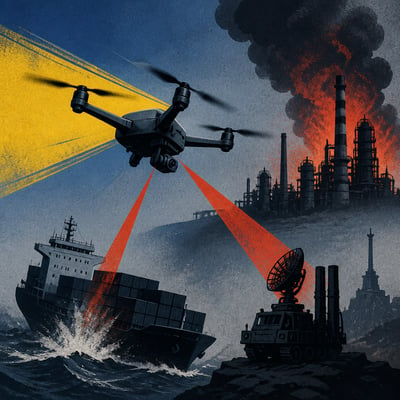
Long-range drone waves increasingly target energy, transport, ports, warehouses, industrial sites and urban areas far beyond front lines.
History
The story shifts from ongoing drone strikes and defense adaptation toward a more entrenched industrial competition, with production facilities becoming targets and mass production of low-cost systems gaining prominence. Peace efforts are now described as stalled, reinforcing the sense of a durable campaign.
The update adds a sharper capacity-and-response dimension: rising attack volumes are now explicitly straining Patriot and other interceptor stocks amid tighter Western supply, while Ukraine accelerates domestic counter-drone development.
The main change is a clearer escalation in attack volume and duration, with waves reportedly reaching hundreds of drones over successive days. The story also now includes protective reinforcement of Russian drone-production facilities, indicating adaptation beyond battlefield air defenses.
The story is increasingly framed as a sustained air-defense and cost-efficiency contest, with low-cost attack and interceptor drones becoming more central. Otherwise, the current version largely confirms the previously established escalation in strike frequency, range and disruption.
The update largely confirms the prior trajectory rather than materially changing it. It adds sharper emphasis on shortages in interceptors and personnel, while naming Wildberries as a commercial logistics actor linked to affected distribution infrastructure.
The current version mainly confirms the established pattern of escalating reciprocal drone warfare, with limited new detail on Ukraine testing domestic interceptor UAVs.
The story is modestly reframed toward a broader reciprocal campaign: Ukraine is now portrayed as developing lower-cost attack systems alongside interceptors, while robotic systems are taking on wider operational roles. The overall escalation, targets, and spillover risks remain largely consistent.
The story now emphasizes technical adaptation: Russia is using more varied and harder-to-intercept drone formations, while Ukraine is testing cheaper interceptor systems. A reported five-drone incursion into Moldova further sharpens the campaign’s cross-border risk.
The main new development is a quantified acceleration of Ukraine’s drone-industrial mobilization, from roughly 800,000 units in 2023 to more than 10 million, with a stated goal of 20 million. The story therefore places greater emphasis on sustained production capacity and external support, not only battlefield strike activity.
The story is reframed more explicitly as an industrial and technological competition over drone volume, range, interception, and production capacity, with spillover now tied to regional airspace and commercial aviation.
The story now includes a major industrial-scale dimension: Ukraine is rapidly expanding domestic drone production, with output rising from roughly 800,000 units in 2023 to more than 10 million and a stated goal of 20 million. This strengthens the interpretation that unmanned warfare is becoming an organized production and force-integration effort, not only an operational adaptation.
The story is increasingly framed as a persistent strategic-disruption campaign rather than solely a front-line weapon contest. New reporting also highlights political promotion of unmanned systems and uncertainty surrounding interception claims.
The current version largely confirms the previous assessment: drone strikes remain intense, long-range, and disruptive, with no major new development or shift in the story.
The story is increasingly framed not only as reciprocal drone attrition but as a broader disruption of transport and industry, with Ukraine treating low-cost interceptor and robotic systems as central military capabilities.
The story now emphasizes concrete air-defense constraints and Ukraine’s move toward domestic interceptor-drone testing, while reported civilian casualties and power outages raise the campaign’s immediate humanitarian impact.
The main new development is that drone warfare’s effects have extended beyond Russia and Ukraine, with five drones reportedly entering Moldovan airspace. Otherwise, the current version largely confirms the established pattern of sustained mass attacks and adaptation by both sides.
The story now emphasizes a quantified peak in Ukrainian strike capacity, with one barrage reportedly involving up to 822 drones. It also adds evidence that Russia is adapting its domestic drone industry defensively by installing protective structures around production facilities.
The story now highlights Ukraine’s largest reported drone attacks toward Moscow and a broader shift toward integrated unmanned warfare beyond one-way strike drones. This raises the perceived scale and strategic significance of the campaign, while confirming continued civilian and infrastructure disruption.
The campaign is now framed as a sustained mixed drone-and-missile escalation rather than primarily reciprocal drone attacks. Ukrainian interceptor-drone development is moving toward accelerated testing, while disruption around neighboring airspace is more explicit.
The story now emphasizes a sharper escalation in scale, with both sides sustaining exceptionally large drone campaigns. Russia is also shown using a broader mix of faster attack drones and decoys, while Ukraine is pursuing domestic interceptor capacity to offset mounting defensive pressure.
The story now includes a higher Ukrainian production target and a clearer maritime dimension, with drone attacks disrupting ports and Black Sea traffic. European support has also moved from general partnership toward concrete procurement commitments and military agreements.
The story is now more clearly framed as an industrial-scale, reciprocal drone war rather than a series of large raids. New production targets and weekly attack totals strengthen the case that mass manufacture and low-cost interception are becoming central strategic requirements.
The story now places greater emphasis on Ukraine’s intended scale-up, including a stated goal of launching 1,000 long-range drones daily. It also adds more concrete warnings that attacks could prolong electricity and heating disruptions, raising the civilian-service stakes.
The story shifts from individual large barrages toward a sustained, reciprocal campaign with broader effects on Ukrainian supply chains and repeated spillover into Moldovan airspace. Ukraine’s drone effort is also more clearly moving into organized, multi-domain robotic warfare.
The campaign has escalated from broad reciprocal drone operations to exceptionally large Ukrainian barrages reaching near Moscow, while reported incidents near Romanian or NATO airspace add a new spillover risk. Domestic drone production, including Fire Point’s emergence in reporting, reinforces Ukraine’s capacity to sustain deep strikes.
The story has shifted from a predominantly Ukrainian strike campaign to an intensified reciprocal air war, with Russian attacks causing significant civilian casualties. Ukraine’s limited Patriot interceptor supply adds a new vulnerability and raises the urgency around defending population centers.
- Russian attacks killed civilians in multiple Ukrainian cities.
- At least 16 people reportedly died in a shopping-center strike.
- Ukraine faces shortages of Patriot interceptors.
- Russian attacks include ballistic missiles alongside drones.
- Ukrainian strikes reportedly hit Novokuibyshevsk and Wildberries- and Ozon-linked logistics sites.
Ukraine carried out a broad drone campaign against Russian-linked maritime, energy, air-defense, and electronic-warfare targets, including the reported sinking of the Rosatom-affiliated container ship Yanina in the Black Sea. Strikes also hit refinery infrastructure in Ufa and military positions near Sevastopol, while Russia reported intercepting 274 drones across multiple regions. The operations show Ukraine extending drone pressure beyond the battlefield toward logistics, fuel production, and defensive infrastructure, with effects including flight suspensions and heightened maritime escalation risks.