
 AI Governance
 Data Centers
 Drones
 Climate
 Privacy
 2026 Maine Senate
 Bob Dylan

Ukraine’s Air Defenses Face Drone Saturation
Coverage from Defence Blog, RBC-Ukraine, and others
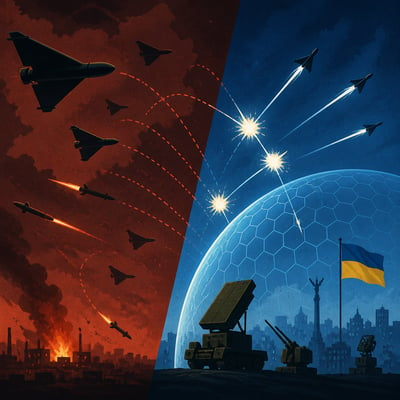
The topic centers on Russia’s repeated large-scale drone attacks against Ukraine, including Shahed and Geran strike drones, faster jet-powered variants, and decoys.
Ukraine is reporting substantial numbers of drones destroyed or electronically suppressed, but some attacks continue to reach cities, industrial sites, ports, residential areas, and other infrastructure, causing casualties and damage. The pattern highlights a continuing contest between increasingly dense drone raids and Ukraine’s mix of air defense missiles, electronic warfare, mobile fire teams, unmanned systems, and emerging autonomous interceptors.
The story gains more specific evidence of Ukraine’s reported interception performance and identifies the organizations developing ZIRKA, but the overall picture remains largely confirmatory.
The story is now framed as reciprocal, high-volume drone warfare rather than primarily Russia’s campaign against Ukraine. It also broadens geographically and operationally, with Ukrainian long-range strikes against military, industrial, logistics, and maritime-related targets in multiple Russian regions.
The story is largely stable, but the updated version reframes the scale of the campaign using a larger reported total of 5,929 Russian air-attack weapons and emphasizes persistent demand on Ukrainian defenses.
The story is reframed from a general saturation contest toward a clearer capacity constraint: high reported drone-neutralization rates still leave Ukraine exposed through impacts, debris, ballistic missiles, and limited interceptor stocks.
The main change is a reframing of Ukraine’s June defense statistics: the reported 89% success rate combines physical interceptions with electronic suppression across all 5,929 reported weapons, rather than focusing only on unmanned aircraft.
The story now emphasizes growing strain on Ukraine’s defensive capacity, with newly reported civilian casualties and damage to port and security infrastructure alongside more detailed interception figures.
The story now places greater emphasis on the consequences and sustainability of Ukraine’s defense: high reported neutralization rates coexist with recurring damage, while scarce Patriot and SAMP/T interceptors remain a constraint against ballistic missiles.
The update materially quantifies the growing jet-powered drone threat, reporting more than 2,800 launches in August and a 72-aircraft daytime wave. It also adds Darknode as a Ukrainian contributor to interceptor development, while otherwise reinforcing the existing escalation pattern.
The story now includes Ukrainian strikes against Russian UAV training and production infrastructure, broadening the contest beyond interception into disruption of Russia’s drone pipeline. New performance figures and reported adaptations reinforce the scale of the threat and the continuing pressure on Ukrainian defenses.
The story shifts from technological adaptation and interception development toward the demonstrated persistence of Russian drone campaigns: even high reported neutralization rates have not prevented repeated penetrations, civilian harm, and infrastructure damage. August reporting also indicates more deliberate use of longer or daytime waves and decoys to exhaust or expose Ukrainian defenses.
The story has shifted from an emerging Russian drone tactic to a sustained, quantified campaign, with Ukraine reporting recurring mass waves and a broader counter-drone response. Ukraine is also taking direct action against Russian UAV training and production infrastructure, while reported defense statistics are increasingly qualified by differing definitions of neutralization.
The story now emphasizes a broader and more technically advanced drone threat, with new details on jet-powered Shahed variants and added survivability features. Ukraine’s response also appears more concrete, with the TALION interceptor joining ZIRKA in operational defense efforts.
The story has shifted from general drone-raid pressure to a more specific technological arms race: Russia is now described as extending attacks over longer periods while modifying Shahed drones for operator control, sensing, and electronic warfare, and Ukraine is answering with cheaper interceptor drones. The addition of ZIRKA and named Russian production capacity makes the contest more industrial and implementation-focused than before.
- Some Russian drones reportedly use remote operators and onboard cameras.
- Russia is adding electronic-warfare gear and air-to-air weapons to Shaheds.
- Ukraine is deploying the low-cost ZIRKA interceptor drone.
- Russian production capacity appears to be increasing at Alabuga.
- NOCTIS and Vyriy Industries are now part of the story.
The story now adds a localized escalation in Zaporizhzhia: Russian drones are reportedly being used to deliver FPV drones into the city and attack civilians. That shifts the emphasis from broad long-range strike waves to a more specific urban counter-drone threat layered onto the existing campaign.
- Shahed drones are reportedly carrying FPV drones into Zaporizhzhia.
- Those FPV drones are being dropped on civilian targets in the city.
- Zaporizhzhia regional authorities are now directly involved in the reporting.
- Urban counter-drone protection has become a more prominent concern.
Russia has continued launching large drone-heavy strike waves against Ukraine, often mixing Shahed-type drones, decoys, and missiles from multiple launch sites in Russia and occupied territory. Ukrainian air defenses regularly report intercepting most of the incoming drones, but some attacks still produce hits and debris across several regions. The material also shows a fast-moving adaptation cycle, with Russia modifying drones to evade interception and Ukraine expanding interceptor drones and layered defenses in response.