
 AI Governance
 Data Centers
 Drones
 Climate
 Privacy
 2026 Maine Senate
 Bob Dylan
Ukraine's Long-Range Drone Strikes
Coverage from Chicago Tribune, Militarnyi, and others
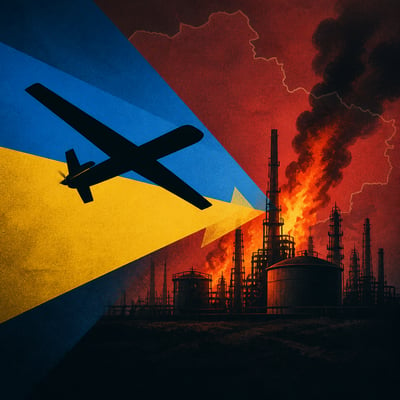
Ukrainian long-range strike drones are repeatedly reaching Russian refineries, fuel infrastructure, defense sites, airbases, and logistics routes, producing reported fires, facility damage, fuel restrictions, and transport disruptions.
Russia continues to report extensive interceptions, but impacts persist across protected and distant targets. The same operational contest extends to Donbas frontline logistics and Black Sea shipping, although the scale of damage and longer-term military effects remain unevenly verified.
The story has broadened from a refinery-focused campaign into a sustained, multi-domain contest involving Donbas frontline logistics and Black Sea maritime activity. Ukrainian strikes are now framed as repeatedly penetrating Russian defenses, while reported effects include transport disruption, pollution, and higher maritime insurance costs.
The story modestly broadens geographically with reported targeting in Ryazan and Rostov and places greater emphasis on Russia’s fuel exports and domestic supply management. The overall assessment remains contested and consistent with the previous version.
The story is modestly reframed toward pressure on Russian fuel production and defense-industrial output, with coverage extending into September. The underlying pattern and uncertainty over damage remain largely unchanged.
The story now emphasizes concrete civilian and infrastructure consequences, including reported casualties, transportation closures, and utility disruptions. It also broadens geographically through a more explicit Ukrainian campaign against military, logistics, and energy targets in occupied Crimea.
The story now links Ukraine’s deep-strike campaign to broader battlefield drone operations in Donbas, while emphasizing that interception claims and damage assessments remain unresolved. This modestly shifts the framing from infrastructure attacks alone toward an integrated, contested drone war.
The story has broadened from a refinery-focused pressure campaign into a deeper contest over Russia’s fuel routes, defense infrastructure, and drone warfare ecosystem. Recent operations reportedly reach Western Siberia and target the systems used to store, launch, coordinate, and defend against drones.
- Reported Ukrainian strikes reached Omsk and Perm, extending the campaign deep into Western Siberia.
- Recent operations targeted drone storage, launch, command, electronic-warfare, and air-defense assets.
- Fuel-route, pumping-station, and export-linked infrastructure became explicit target categories.
- Counter-UAS efforts now include interceptor drones, mobile radar, and expanded electronic-warfare systems.
- Satellite-denied navigation, repeater communications, and autonomous systems became prominent technical priorities.
The story now more explicitly includes gas-processing facilities and identifies President Vladimir Putin as responding to acknowledged fuel shortages. The assessment also places greater emphasis on uneven strike effectiveness and disputed or unverified claims, despite mounting pressure on Russian fuel and military supply networks.
The campaign now has a reported fatality at a targeted refinery and clearer evidence of Russian supply-management and repair responses. It also appears to encompass a broader set of military targets, including aircraft, missile components, and air-defense systems, including in occupied Crimea.
Ukraine is expanding the scale and reach of drone strikes against Russian refineries, fuel facilities, military-industrial sites and logistics networks, including targets far beyond the front line. Reported attacks have caused fires, temporary airport closures, infrastructure damage and pressure on fuel supplies, while Russian authorities have increased air-defense measures and taken steps to protect domestic fuel availability. The effectiveness and damage attributed to individual strikes remain unevenly confirmed, but the reporting indicates a sustained campaign intended to disrupt Russia’s war-supporting industry and logistics.