
 AI Governance
 Data Centers
 Drones
 Climate
 Privacy
 2026 Maine Senate
 Bob Dylan

Ukraine-Russia Drone Strike Escalation
Coverage from The New York Times, The Guardian, and others
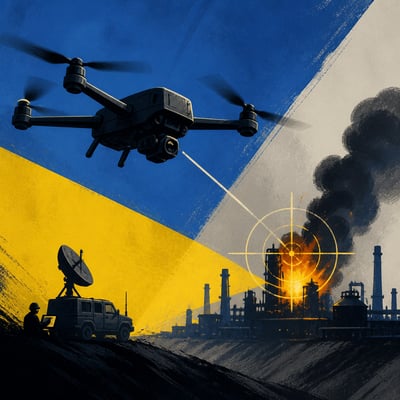
Ukraine and Russia are escalating drone warfare across the battlefield and deeper rear areas, with mid-range strikes, FPV attacks, and loitering munitions becoming central to operations.
The reporting points to Ukraine improving its ability to hit logistics hubs, command posts, airfields, and support infrastructure, while Russia continues adapting its Shahed-derived attack drones and countermeasures. The main significance is operational: drone capabilities are increasingly shaping battlefield momentum, air defense burden, and the resilience of supply lines on both sides.
The story has shifted from Ukraine’s interceptor-drone air defense against Russian Shahed attacks to a broader offensive campaign using domestically produced midrange drones to disrupt Russian logistics in the south. The new version adds concrete strike claims, operational scale, and Russian countermeasures that make the campaign look more sustained and consequential.
- Ukraine is using midrange drones for offensive strikes on Russian logistics.
- The K-2 brigade reported launching 800 drones in May.
- Starlink supports control of fixed-wing drones beyond frontline range.
- Russia is countering with mobile air defenses and interceptor teams.
- Russian forces are reportedly repairing and reusing captured Ukrainian heavy drones.
The story has shifted from Ukraine’s broader drone offensive roles to a new air-defense race centered on interceptor drones against Shahed and Geran attack waves. The current version adds a clearer technology competition with Russia, emphasizing remote operation, AI assistance, and jet-powered interceptors as Ukraine tries to preserve an affordable defense.
- Ukraine is scaling low-cost interceptor drones against Shahed and Geran attacks.
- Russia is fielding faster jet-powered Geran variants, including reported Geran-4.
- Ukrainian systems now use remote control and AI-assisted detection and targeting.
- Jet-powered Griffen is an emerging Ukrainian interceptor response.
- The cost gap with conventional air defenses is now central to the story.
The story has shifted from leadership uncertainty over Ukraine’s drone strategy to concrete battlefield evidence that Ukrainian drone units are expanding into a broader operational toolkit. The new reporting shows specialized units using multiple drone types for strikes, logistics, and resupply, with operators taking on more specialized roles.
- 414th Brigade used fiber-optic FPV drones near Myrnohrad.
- 414th and 413th units reported 21 strikes up to 100 kilometers from the front.
- VORON battalion operates multiple drone types in Donetsk.
- Heavy Shot drones deliver supplies to forward positions at night.
- Women are serving as combat drone pilots in operational roles.
The story has shifted completely from a drone-technology testing update to a political and institutional question about Ukraine’s defense reform after Fedorov’s dismissal. The new focus is whether leadership change will slow or preserve the decentralized drone ecosystem that has shaped wartime procurement and innovation.
The story has shifted entirely to Quantum Systems’ high-speed electric aircraft testing and planned interceptor-drone development. The key new development is a reported 699 km/h test run that is not yet officially certified and has not been shown to translate into operational interception capability.
- Quantum Systems reported Apex Recordhunter reached 699 km/h in testing.
- FAI certification of the speed is still pending.
- WIY Drones is preparing STRILA and SPYS interceptor tests.
- Apex is a technology demonstrator, not an operational interceptor.
- Operational interception performance remains unproven.
The story has shifted from Ukraine’s drone-autonomy advances to Russia’s active recruitment of students into military drone units, with Ukraine’s simulator training presented as a parallel response to operator shortages and losses. The new emphasis is on how both sides are treating drone operators as a scarce, high-risk military resource.
- Recruitment outreach has reached at least 95, possibly nearly 270, Russian universities.
- Students are being offered contracts with pay, academic leave, tuition support, and training.
- Some recruits have been killed after training or transfer to drone units.
- Russia is targeting students with drone, electronics, and radio-engineering experience.
- Ukraine’s simulator has trained more than 7,000 military operators.
The story has shifted from Russian student recruitment for drone warfare to Ukraine’s move toward AI-assisted and partially autonomous targeting. The key new issue is not training volume, but whether Ukrainian drone strikes can be made more autonomous, resilient to jamming, and broadly adopted after military approval.
- Ukraine is integrating reconnaissance networks with strike drones for layered attacks.
- AI already assists target detection, image highlighting, and terminal guidance.
- Trident is scaling a modular targeting system for fixed-wing and multirotor drones.
- Autonomous target selection is still in early combat testing.
- Wider adoption depends on Ukraine’s General Staff codification and approval.
The story has shifted from drone autonomy on the battlefield to Russia’s effort to staff its expanding drone forces by recruiting students, with Ukraine’s simulator-based training emerging as the counterpoint. The new emphasis is less on technology alone and more on manpower, training, and the risks of treating drone service as a safe technical role.
- Russia is recruiting students through military drone contracts.
- Recruitment offers include pay, academic leave, tuition support, and training.
- Reports say recruits can be transferred from drone roles to combat units.
- Ukraine’s simulator has trained over 7,000 operators.
- At least one student recruit, Valery Averin, was reportedly killed.
The story has shifted from broad drone warfare escalation to a more specific evolution in drone autonomy: Ukrainian systems are now moving AI-assisted recognition and terminal guidance into operational use. The emphasis is less on strike volume and more on how autonomy may make drones more resilient in jammed environments and improve attacks on mobile rear-area logistics.
- Trident is scaling a modular autonomous targeting system.
- The system processes daylight and thermal imagery.
- Ukrainian units are combining reconnaissance, data fusion, and strike drones.
- AI-assisted functions are already being used operationally.
- Fully autonomous target selection remains in early combat testing.
The story now places greater emphasis on Russia’s drone adaptation and the operational effects on aircraft and airbases, not just broader battlefield strike use. It also adds a more specific claim that autonomous AI target selection is still early-stage rather than mature.
- Russia is adapting Shahed-derived drones with anti-jamming tools and cameras.
- A newer Russian variant, Geran-4, is reported.
- Drone strikes are reportedly affecting Ukrainian MiG-29 survivability at airbases.
- Autonomous target selection appears early-stage, not fully mature.
- Interceptor drones and automatic guidance systems are becoming more prominent.
The story has shifted from a broad account of drone escalation to a clearer emphasis on operational maturity: drones are now being described as core battlefield systems on both sides, with Ukraine leaning more on longer-range and AI-assisted strike methods while Russia scales layered defenses and unmanned-force structure. The commercial angle is less prominent than before, and the focus is now squarely on combat use, production scale, and battlefield adaptation.
The story has shifted from a broad escalation in drone warfare to a more operationally detailed picture of how Ukraine is using drones deeper behind Russian lines and how Russia is responding with expanded defenses and unmanned-force buildup. The new emphasis is on fielded remote-control, AI targeting, and counter-drone systems, alongside a clearer cost-imbalance dynamic.
The story now puts more emphasis on the widening drone ecosystem, especially counter-drone technologies and non-strike missions, rather than mainly on Ukraine’s offensive use of drones. It also adds more concrete evidence of Russia’s response through recruitment, doctrine, and mass production plans.
Ukraine’s drone effort has become a central part of the war, combining long-range strikes, battlefield reconnaissance, interception systems, and emerging AI-enabled targeting. The material shows Ukraine using drones to hit Russian infrastructure, disrupt logistics, and pressure Russian forces while also trying to close its missile gap with domestic development. Russia remains active in drone warfare too, but the dominant pattern is Ukraine’s faster adaptation and growing tactical advantage.