
 AI Governance
 Data Centers
 Drones
 Climate
 Privacy
 2026 Maine Senate
 Bob Dylan
Ukraine Expands Drone Defense Exports
Coverage from Defense News, Euromaidan Press, and others
Ukraine is using experience from its war with Russia to expand production, refine low-cost drone and counter-drone systems, and build defense partnerships across Europe, the Middle East, and NATO.
Its offerings include FPV strike drones, interceptor drones, electronic warfare, detection networks, and maritime systems, supported by training, licensing proposals, and joint development programs. The shift could widen access to combat-tested defenses against drones, while export controls, domestic military needs, and uncertain procurement decisions may limit near-term scale.
The story broadens from a general export-and-partnership push into a more concrete production and scaling effort, with added detail on maritime systems and U.S. interest in Ukrainian lessons. It also now emphasizes that export controls and domestic wartime demand may materially constrain near-term growth.
The story has shifted from battlefield drone adaptation to a more explicit export-and-partnership strategy, with Ukraine now actively packaging combat experience for foreign buyers and collaborators. The biggest new development is the proposed Drone Deals framework, which could formalize exports while balancing domestic supply constraints.
- Proposed Drone Deals would expand Ukrainian exports beyond drones alone.
- NATO and Brave1 opened a €10 million matched-grant counter-drone program.
- Reported cooperation now includes Saudi Arabia, Qatar, and the UAE.
- Ukraine is marketing combat-tested drone and electronic warfare methods to foreign partners.
- Export scale may be limited by licensing, wartime demand, and procurement uncertainty.
The story has shifted from Ukraine mainly leveraging battlefield drone experience into a more institutionalized ecosystem centered on procurement, production, and allied integration. The new reporting also adds more concrete evidence of operational limits, especially from electronic warfare, identification failures, and friendly-fire risk.
- UK announced transfer of Stone Cloak electronic-warfare IP to Ukraine.
- Brave1 Market and Brave1-NATO grant program are formalizing procurement.
- Ukraine is now linked to controlled F10 shipments for U.S. export.
- U.S. programs are pursuing cheaper, scalable interceptors and attack drones.
- Friendly fire and identification problems are newly highlighted.
The story is modestly more concrete: Ukraine’s drone diplomacy now includes specific partner targets and a reported U.S. export authorization tied to the Pentagon’s competition. It also places greater emphasis on expanded domestic interceptor production and on foreign financing being linked to wartime drone performance.
The story now emphasizes Ukraine’s move from simply building and using drones to formalizing them as an exportable defense product, with limited exports already authorized for a U.S. military competition. It also adds a new internal political wrinkle: leadership disputes over drone procurement and military technology are now part of the narrative.
- Six companies were authorized to export limited drones to the U.S. competition.
- Ukraine is pursuing drone and air-defense agreements with NATO and Gulf states.
- Mykhaylo Fedorov’s removal exposed defense-priority disputes.
- Domestic systems now integrate radar, sensors, video feeds, and interceptor drones.
- Wartime controls and production limits may restrict deliveries.
The story has shifted from a mainly wartime innovation narrative to one centered on formalized export, procurement, and partnership channels. Ukraine’s drone ecosystem is now being presented less as improvised battlefield adaptation and more as a scalable defense-industrial asset attracting foreign buyers.
- Ukraine is moving into more formal export and partnership channels.
- MBDA and Hybrid Drones are now part of the story.
- The U.S. Department of Defense is evaluating small attack drones.
- Casualty evacuation drones are highlighted as a distinct use case.
- Battle-tested, cost-competitive systems are attracting foreign buyer interest.
The story has shifted from a points-based battlefield procurement system to a broader drone-warfare ecosystem centered on production scaling, counter-drone defense, autonomy, and export policy. Ukraine’s drone lessons are now being operationalized not just on the front line but across allied training and foreign sales channels.
- Drone production is scaling across FPV, loitering munition, and interceptor categories.
- Ukraine is testing more autonomous Shahed interception systems.
- Battlefield lessons are feeding NATO exercises and U.S. training.
- Ukraine is preparing reciprocity-based arms and drone export sales.
- Operational limits include friendly-fire losses and electronic warfare saturation.
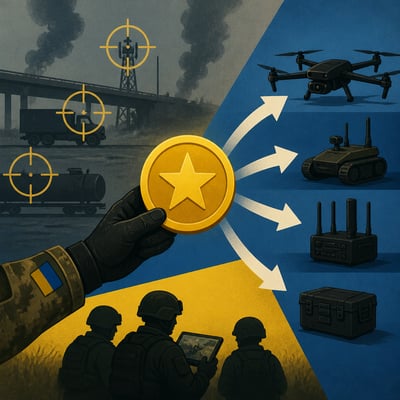
Ukraine is using an incentive system that awards frontline units points for verified battlefield results, then lets them spend those points on drones, robotics, electronic warfare gear, and other equipment. The system is shaping targeting behavior by pushing units toward higher-value Russian targets, including logistics and rear-area infrastructure, while also speeding decentralized procurement and feedback from frontline users. It matters because it links combat performance to equipment supply and may be helping Ukraine adapt more quickly in drone-heavy warfare.