
 AI Governance
 Data Centers
 Drones
 Climate
 Privacy
 2026 Maine Senate
 Bob Dylan
Ukraine Turns Drone Know-How Into Alliances
Coverage from Kyiv Post, WTOL, and others
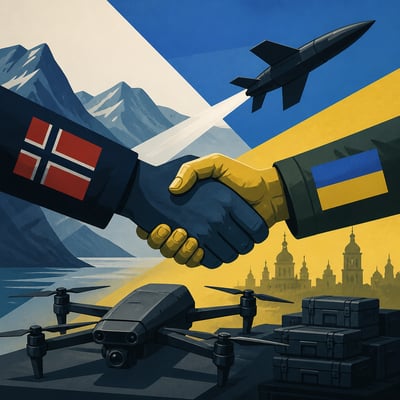
Ukraine is using combat-developed drone, interceptor, and electronic-warfare capabilities to build defense partnerships and joint production arrangements with the United States, Canada, Germany, Norway, and other countries.
Proposed and signed agreements aim to move Ukrainian designs and manufacturing into allied supply chains while expanding production for wartime and homeland-defense needs. The pattern could give Ukraine additional financing and industrial capacity, but several arrangements remain drafts, planned facilities, or undisclosed in scale.
The story is reframed from allied procurement and production planning toward Ukraine using drone and electronic-warfare expertise as an export, diplomatic, and industrial asset, with possible U.S. technology exports and Middle Eastern engagement newly emphasized.
The story has moved from largely proposed partnerships toward concrete procurement targets and a new Canadian production track, making allied industrial integration more tangible and larger in scale. Ukraine also reports a sharp increase in interceptor-drone deliveries, though production outcomes and performance remain unevenly verified.
- U.S. Drone Dominance ordered 2,000 prototypes and targets over 200,000 drones by 2027.
- Canada plans millions of military drones within two years, with one-third intended for Ukraine.
- Germany is funding or ordering 50,000 Shrike attack drones and 15,000 Strila interceptors.
- Ukraine says interceptor deliveries doubled in early 2026 versus all of 2025.
- Ohio assembly plans now include training, testing, and localized supply chains.
The story has moved beyond proposed exports and production partnerships: Germany is now financing Ukrainian attack and interceptor drone output, while Ukrainian systems and personnel are supporting counter-drone operations in the Middle East. This broadens Ukraine’s role from technology supplier to operational defense partner, though funding, approvals, scale, and disclosure risks remain constraints.
The story is now more concrete about where and how Ukraine’s drone-industrial partnerships are progressing, especially by adding named U.S. manufacturing efforts and a clearer emphasis on counter-drone capabilities. It also broadens the partnership set with additional European and Middle Eastern buyers, while keeping the same core constraints around funding and approvals.
The story has shifted from mostly proposed bilateral drone-production plans to a more concrete implementation phase, highlighted by a signed Norway-Ukraine production agreement and active U.S. facility planning. The emphasis also broadened toward autonomous, communications-disrupted systems and away from the earlier focus on export restrictions and security constraints.
- Norway and Ukraine signed a Build with Ukraine agreement.
- Initial systems are expected to be produced in Norway for delivery to Ukraine.
- FPV and interceptor drone assembly is planned in Ohio and New Hampshire.
- Reported systems emphasize jamming-resistant navigation and autonomous target pursuit.
- The current framing includes Europe, the Middle East, and other partners.
The story now includes a concrete bilateral step: Ukraine and the United States drafted a memorandum on joint military-drone manufacturing and possible Ukrainian exports of electronic-warfare technology. It also broadens from general allied production to a more specific mix of partner countries, named firms, and a new U.S. infrastructure/security angle.
- U.S.-Ukraine memorandum drafted for joint military-drone manufacturing
- Possible Ukrainian exports of electronic-warfare technology
- Planned UDD/F-Drones facility in Ohio
- Unauthorized drone flights reported over sensitive U.S. ports
- Named manufacturers and suppliers added to the story
The story has shifted from broad alliance-building around Ukrainian drones to a more concrete procurement-and-manufacturing pipeline, especially in the United States and Europe. It now emphasizes execution details and unresolved governance issues, including supply-chain, IP, and oversight constraints.
- U.S. Drone Dominance links prototype orders to industrial scaling.
- Norway launched Build with Ukraine for European drone production.
- Interceptor drones are now central to air-defense and base-protection plans.
- Battlefield-derived strengths now include GPS-denied navigation and EW resilience.
- A contracting investigation raises oversight concerns in Ukraine.
The story now emphasizes Ukraine as an exporter and defense-technology provider, with more explicit evidence of overseas production steps and a sharper contrast between signed cooperation and unsigned U.S. ambitions. It also adds a stronger focus on drone systems as a way to supplement scarce air-defense missiles.
The story has broadened from a set of Ukraine-centered drone partnerships into a larger international production and procurement push, with the EU, Germany, Canada, and U.S. industry now featured more prominently. The main new wrinkle is that several high-profile arrangements are moving into concrete execution or testing, but some remain unsigned or only partially implemented.
- EU bloc-wide production arrangement for Ukrainian drone expertise
- Germany funding 50,000 Shrike FPV drones for Ukraine
- Canada-Ukraine agreement to produce drone systems in Canada
- U.S. testing Ukrainian aerial and maritime drones
- UDD Tech plans 300-job assembly plant in Ohio
The story has broadened from general drone production and interceptor cooperation into a more specific alliance-and-industry network centered on co-production, technology transfer, and export controls. The biggest new development is that Norway, Romania, and the U.S. are now tied to concrete or draft arrangements that could institutionalize Ukrainian drone know-how beyond wartime use.
- Norway agreed to co-produce mid-strike drones for Ukraine.
- A U.S.-Ukraine draft memo would permit Ukrainian military technology exports.
- Romania’s drone program is tied to combat-tested Ukrainian designs.
- Terra Drone opened an Estonia-based defense unit.
- Rep. Pat Harrigan is pushing to phase out Chinese-made drones.
The story has shifted from broad wartime drone cooperation to a more concrete commercialization and industry-consolidation phase, led by Terra Drone’s move to unify Ukrainian interceptor-drone developers and push named products into deployment. That adds a new private-sector execution layer on top of the existing state-to-state production and procurement narrative.
The story has broadened from allied drone production and procurement into a more explicit export-and-industrialization framework, with Canada and Japan now among the named partners. It also sharpens the operational focus on interceptor drones and jam-resistant navigation as the core capabilities being transferred and produced.
The story has broadened from a mostly Europe-centered drone-production and export narrative into a more explicit transatlantic and industrial-cooperation story, with the U.S. now framed alongside Germany, Norway, Poland, and Romania. The emphasis also shifts further toward training and doctrine as part of the drone partnership, not just manufacturing and procurement.
The story has broadened from bilateral drone production deals into a wider drone-industrial diplomacy push, with clearer emphasis on allied procurement channels, joint venture frameworks, and export-oriented cooperation. It now reads less like wartime experimentation and more like an emerging transnational defense manufacturing network.
The story now places more emphasis on execution status: several drone partnerships are no longer just strategic intent, but are tied to summer 2026 production or delivery timelines. It also adds a clearer caution that some of the reported deals are still preliminary, with draft memoranda and announced intent rather than finalized contracts.
The story now places greater emphasis on Ukraine's drone effort as an exportable defense-industrial program, not just a wartime procurement push. It also adds a stronger signal that co-production abroad and technology transfer are becoming central to the strategy.
The story has shifted from a broad expansion of drone partnerships to a more concrete, execution-focused picture: Ukraine is now emphasizing active joint manufacturing, faster interceptor deliveries, and deployment of jam-resistant systems. The updated framing also makes the export-and-procurement system more central, with organized channels and controls shaping how these capabilities scale.
The story now emphasizes a broader international production network and a stronger shift toward partner-funded manufacturing and technology transfer, rather than mainly wartime production deals. It also adds more explicit procurement and financing integration around that industrial scaling effort.
The story has broadened from mainly Norway-linked drone production into a wider international defense-industrial push, with new cooperation signals from Germany and the United States. It also now emphasizes structured procurement and export of combat-tested systems, not just manufacturing scale-up.
- Germany is now identified as a defense technology partner and funding backer.
- U.S. State Department participation is referenced in drone cooperation talks.
- Procurement channels now include bonus programs and new permit mechanisms.
- Ukraine is packaging electronic warfare and battle-management systems for export.
- Some large production and funding claims are still unverified or security-sensitive.
The story has sharpened from general wartime drone scaling into a more concrete execution phase, with new emphasis on direct procurement channels and interceptor-drone deployment for air defense. Norway remains central, but the current version adds clearer evidence that Ukraine is operationalizing these partnerships through production in Norway and back-transfer to Ukraine.
The main update is that Ukraine’s drone effort has shifted from general scaling to a clearer wartime production-and-delivery push: interceptor drone procurement is now ramping faster, while joint manufacturing with Norway has become more concrete with a first delivery timeline. This makes the story more about operational scaling and industrial execution than earlier, broader partnership plans.
Ukraine is expanding drone production, procurement, and export partnerships while scaling interceptor drones for air defense. Norway is joining Ukrainian drone manufacturing, and Ukraine is using wartime production capacity to support both domestic needs and foreign buyers.