
 AI Governance
 Data Centers
 Drones
 Climate
 Privacy
 2026 Maine Senate
 Bob Dylan

Russia-Ukraine Jet Drone Escalation
Coverage from Liga.net, Kyiv Post, and others
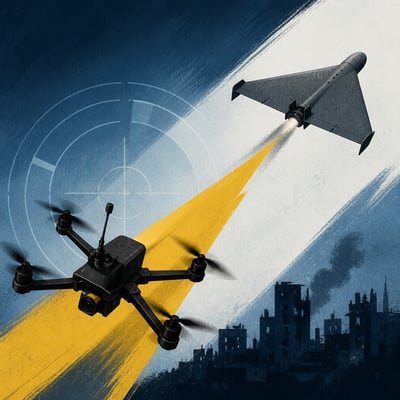
Russia is scaling jet-powered Geran and Shahed strikes against Ukraine, while Ukrainian forces test faster, lower-cost interceptors and layered defenses to restore interception capacity.
Ukrainian counter-drone efforts have progressed from development and testing to field trials of multiple specialized interceptors, although guidance and production scale remain unresolved. The update also clarifies that Russia is iterating domestically produced Geran variants using foreign components and battlefield feedback.
The update makes the air-defense challenge more concrete: Ukraine reportedly achieves lower destruction rates against faster drones, which also carry heavier warheads. It also indicates that specialized Ukrainian interceptors are moving closer to deployment.
The story now adds meaningful detail on both sides: Ukraine is pursuing an autonomous Terra A1 interceptor, while Russia’s production expansion may be constrained by jet-engine and foreign-component dependencies. This shifts the framing from an unqualified Russian capability increase toward a scale contest with industrial and inventory limits.
The story is increasingly framed around the uneven readiness and uncertain effectiveness of Ukraine’s counter-drone response, rather than simply the development of new systems. Laser defenses are now described as nearing initial operational capability but not broadly deployed, while conventional air defenses remain essential.
The story now has a clearer measure of escalation: Russia reportedly launched nearly 1,500 drones in four days, including about 800 jet-powered systems. New details also indicate continued foreign-component use despite sanctions and identify additional Ukrainian counter-drone systems.
The story has shifted from Russia fielding faster Geran drones to emphasizing their expanding production and broader use against military, industrial, logistical, and civilian targets. Ukraine’s response is also framed more broadly, adding low-cost missiles, programmable munitions, and newly identified autonomous and laser-defense developers.
The story now has clearer evidence that Russia’s jet-powered drone campaign is intensifying, with reported launches rising sharply in July and August 2026. Ukraine’s response is shifting from prototype development toward field testing and mass production of affordable defenses designed for sustained barrages.
The story has shifted from largely developmental counter-drone innovation toward an active adaptation cycle, with Russia using mixed drone formations and electronic-warfare tactics. The threat is also framed more explicitly around ports, shipping, and critical infrastructure.
The story now places more emphasis on practical execution: Ukraine’s counter-drone effort has shifted from a broad development race to specific systems entering production or initial operational use, while laser defenses are newly foregrounded as a lower-cost answer to mass drone attacks. The core threat from faster Russian jet-powered drones remains the same, but the current version frames the response as more mature and operationally focused.
The story has broadened from mainly interceptor drones to a wider counter-drone stack that now includes AI autonomy, satellite-linked remote operations, and directed-energy defenses. The main new framing is that Ukraine is responding to faster jet-powered attack drones with multiple layered systems, though performance remains hard to verify.
- Directed-energy systems are now part of Ukraine's counter-drone response.
- Satellite-linked remote control is being used to extend operator reach.
- AI is moving into terminal guidance and autonomous pursuit.
- Russian electronic warfare is shaping countermeasure development.
Ukraine is expanding the use of relatively low-cost interceptor drones against Russian Shahed- and Geran-type attack drones. Manufacturers are moving pilots away from exposed frontline positions, adding AI-assisted detection and terminal guidance, and developing faster interceptors as Russia deploys more capable jet-powered variants. The shift could reduce reliance on expensive surface-to-air missiles, but effectiveness remains dependent on weather, sensors, connectivity, pilot skill, electronic warfare, and production scale.