
 AI Governance
 Data Centers
 Drones
 Climate
 Privacy
 2026 Maine Senate
 Bob Dylan

Skydio F10 and MegaDock
Coverage from DroneXL, The Drone Girl, and others
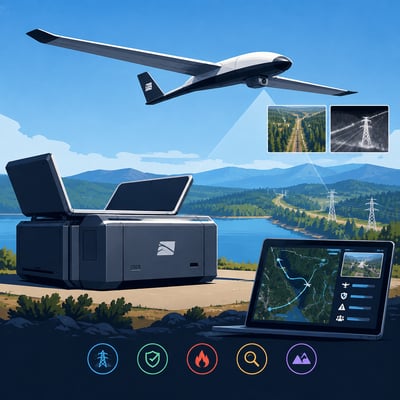
The Skydio F10 Lightrunner is a fixed-wing drone designed for extended-range operations, including asset inspection, search and rescue, and emergency response.
It combines onboard vision and autonomous navigation with visible and thermal imaging, while MegaDock can store and autonomously launch and recover a fleet of up to five aircraft. Skydio’s command and fleet software connects aircraft, mission operations, and inspection imagery, supporting remote and repeatable work across public safety and infrastructure settings.
If you read one thing
It gives a clear, well-rounded introduction to the F10’s flight capabilities, imaging, autonomy, and MegaDock’s role in persistent operations.
The evidence
It adds concrete operational details, including aircraft rotation and the parachute’s intended relevance to Category 3 flights over people.
F10 combines fixed-wing range with autonomous flight
The F10 is presented as a fast, long-endurance fixed-wing aircraft with onboard vision for navigation and obstacle perception. Its stated range and endurance, autonomous operation, and visible/thermal imaging define its proposed capabilities for inspection and response missions.
MegaDock enables automated aircraft rotation
MegaDock is designed to store, launch, recover, and recharge multiple F10s, allowing aircraft handoffs while others recharge. The aircraft-and-dock pairing is positioned to support persistent, remotely managed operations with less reliance on runways and on-site crews.
48-megapixel megapixels
telephoto camera resolution
“The payload combines a 48-megapixel telephoto camera with a 190 mm equivalent lens, a 64-megapixel narrow camera with a 46 mm equivalent lens, and a FLIR Boson+ 640×512 thermal sensor.”
100 mph (44 m/s)
maximum speed
“The 15.4-pound (7 kg) F10 has a polymer-skinned foam airframe and is described as NDAA-compliant. Its stated specifications include a maximum speed of 100 mph (44 m/s), up to 120 minutes of endurance, a 30-mile coverage radius, and 20 seconds from dock trigger to airborne.”
120 minutes
maximum stated endurance
“The 15.4-pound (7 kg) F10 has a polymer-skinned foam airframe and is described as NDAA-compliant. Its stated specifications include a maximum speed of 100 mph (44 m/s), up to 120 minutes of endurance, a 30-mile coverage radius, and 20 seconds from dock trigger to airborne.”
15.4-pound (7 kg)
F10 aircraft weight
“The 15.4-pound (7 kg) F10 has a polymer-skinned foam airframe and is described as NDAA-compliant. Its stated specifications include a maximum speed of 100 mph (44 m/s), up to 120 minutes of endurance, a 30-mile coverage radius, and 20 seconds from dock trigger to airborne.”
20 seconds
time from dock trigger to airborne
“The 15.4-pound (7 kg) F10 has a polymer-skinned foam airframe and is described as NDAA-compliant. Its stated specifications include a maximum speed of 100 mph (44 m/s), up to 120 minutes of endurance, a 30-mile coverage radius, and 20 seconds from dock trigger to airborne.”
The new article reiterates the F10 and MegaDock announcement but provides no material new development about this platform; its other fresh details concern different Skydio aircraft.
Previously
Skydio introduced the F10, its first fixed-wing aircraft, alongside MegaDock and software for inspection and security workflows. The F10 is designed for speeds up to 100 mph, a 30-mile operating radius, and up to 120 minutes of flight. MegaDock can hold up to five aircraft and support autonomous launch and recovery. Customer deployments are expected in 2027, so the announced specifications and operating model have not yet been validated by deployment evidence in this material.