
 AI Governance
 Data Centers
 Drones
 Climate
 Privacy
 2026 Maine Senate
 Bob Dylan

UK Puts Drones At Center
Coverage from Twz, Forces News, and others
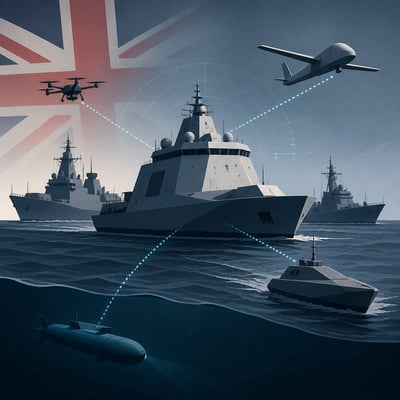
The United Kingdom is placing drones and autonomous capabilities at the center of a new defense investment plan, with more than £5 billion allocated over four years across the Army, Royal Navy, and Royal Air Force.
The program includes armed and surveillance drones, autonomous naval vessels, drone wingmen, electronic-warfare aircraft, and a new Uncrewed Systems Task Force intended to speed procurement and deployment. The shift could expand Britain’s capacity for surveillance, strike, electronic warfare, and maritime sensing, but it also raises questions about affordability, data-link resilience, legal accountability, and whether smaller autonomous platforms can replace the air-defense, missile, and command functions of major warships.
The story now centers more explicitly on the UK’s four-year defense investment plan and the new delivery task force, while adding clearer service-level detail on Army FPV/interceptor drones and RAF electronic-warfare aircraft. It also sharpens the unresolved issues around legal accountability and whether drones can meaningfully substitute for major warship functions.
The story has shifted from a broad UK drone buildup to a more concrete, cross-service implementation phase, with specific procurement, testing, and industrial-production signals now visible. It also broadens beyond UK plans to include a U.S. combat-drone test that reinforces manned-unmanned teaming while keeping human control over lethal decisions.
- Project Corvus is moving toward procurement of Tekever AR5 reconnaissance drones.
- Swindon capacity is being expanded for testing and manufacturing.
- Ship-launched Nyan strike drones have been demonstrated.
- Kraken K3 Scout uncrewed surface vessels were dropped by parachute in trials.
- The YFQ-44A Fury tested inert beyond-visual-range engagement with human lethal authority preserved.
The story now places more emphasis on how the UK is actually organizing and fielding drone capabilities across the services, especially with the Royal Navy's hybrid fleet plans and the Army/RAF's specific platform programs. It also adds sharper constraints around human authorization, jamming resilience, and procurement capacity, making the effort look more operationally detailed but still bounded by implementation limits.
The story has broadened from a primarily naval hybrid-fleet debate into a cross-service UK defense procurement push centered on drones, autonomy, and faster fielding. What was once a planning concept is now presented as active funding, task-force coordination, and live trials across the Army, Navy, and Air Force.
- More than £5 billion committed to drone and autonomous programs.
- Uncrewed Systems Task Force created to speed rollout.
- Carrier, shipborne, and airdropped drone trials are now underway.
- Army and RAF are now central to the drone transition.
- Critics highlight survivability, integration, and communications resilience limits.
No material change is evident between the previous and current versions. The core narrative, planned capabilities, timeline, and cast of actors all remain the same.
Britain is reshaping Royal Navy planning around a hybrid fleet that combines crewed warships with drones, autonomous vessels, and control ships. The center of the change is a new class of Common Combat Vessels that would coordinate uncrewed systems across air, surface, and subsurface domains, while older destroyer and frigate plans are being revised or deferred. The debate matters because it exposes a broader tradeoff between buying more autonomous capability and maintaining enough traditional warships to meet standing commitments.