
 AI Governance
 Data Centers
 Drones
 Climate
 Privacy
 2026 Maine Senate
 Bob Dylan

Police First-Responder Drone Expansion
Coverage from BBC News, Los Angeles Times, and others
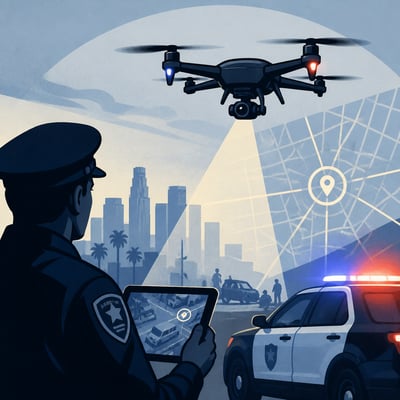
Police departments are rapidly expanding first-responder drone programs to reach 911 calls faster, provide live aerial video, and support search, pursuit, and scene assessment.
The strongest signal is municipal adoption in major and suburban U.S. cities, alongside privacy reviews, vendor trials, and limits tied to crashes, connectivity, and flight endurance.
The story now centers more clearly on large-scale municipal adoption, with Los Angeles emerging as the clearest high-volume operator and Fort Worth and Minneapolis adding new trial-and-governance developments. The competitive landscape is also sharper, with named vendors and procurement choices becoming more visible.
- Los Angeles reported thousands of drone deployments.
- Fort Worth launched a one-year vendor-neutral DFR trial.
- Minneapolis city officials are advancing a DFR evaluation.
- Vendor competition now includes Flock Safety, Skydio, and Brinc.
- Adoption is spreading across suburban and mid-sized cities.
The story has shifted from broad municipal adoption to a more operationally mature phase, where drone-first-responder systems are now being scaled through new purchases, docked infrastructure, and tighter integration with dispatch. The main new emphasis is on routine use and efficiency gains, while privacy and reliability constraints remain persistent.
The story has widened from a broad municipal drone-response trend into a more operationally specific and geographically expanded rollout, with new emphasis on live-video dispatch integration and sensor fusion. Omaha and Riverside County emerge as new major actors, and drone programs are now tied more clearly to gunshot detection and broader emergency operations.
- Omaha Police Department appears as a new active deployer.
- Riverside County Sheriff's Department is proposing a regional fleet and intelligence center.
- Drones are now paired with gunshot detection systems.
- Programs are integrating live aerial video with dispatch operations.
- Mission creep is now named as a recurring concern.
The story has sharpened from a broad multi-city rollout into evidence of routine, sustained drone-as-first-responder adoption, with clearer examples of municipal fleet expansion and long-running deployments. The current version also adds more concrete actors and procurement signals, while the core privacy and safety concerns remain unchanged.
- Stockton City Council approved a multiyear drone and camera-network expansion.
- Some programs in Chula Vista and Minnetonka have operated since 2018 or earlier.
- LAPD, Chula Vista, Minnetonka, and Stockton show sustained adoption and fleet expansion.
- Flock Safety, Skydio, DJI, and Brinc are now explicit named actors.
- Drone-response programs are described as moving into routine public-safety use.
The story is now more clearly framed as a broader, spring-2026 rollout of police drone response programs, with formal launch infrastructure and integrated surveillance systems becoming more prominent. The main change is a shift from general expansion concerns to specific operational and oversight constraints, including live video, thermal imaging, and tighter scrutiny of privacy and council approval.
The story has broadened from a general pattern of municipal drone-first-responder adoption into a more concrete operational and procurement phase, with specific cities reporting heavy usage, new buying plans, and deeper system integrations. The current version also adds a stronger emphasis on safety, data, and compliance as these programs scale.
- LAPD reported more than 3,000 drone deployments in one year.
- Minnetonka logged 600-plus drone flights.
- St. Louis is planning an aerial response unit with BRINC drones.
- Minneapolis is evaluating a Drones as First Responders program.
- AirData appears as a fleet data and compliance platform.
The story has broadened from mainly police-led drone-first-responder programs to a wider public-safety rollout that now includes fire and EMS agencies, city oversight bodies, and more vendor/platform involvement. The updated coverage also signals more mature operational deployment, with agencies using drones across a wider range of incidents and scaling supporting infrastructure.
The story now looks less like a broad rollout of drone-first-responder programs and more like a mature, operational deployment phase led by a few large, high-volume agencies. Coverage also broadens from general adoption to the practical constraints of scaling these programs, especially cost, staffing, airspace compliance, and data governance.
The story has shifted from general expansion of public-safety drone programs to a more concrete picture of scaled deployment across specific police departments and regions. The current version also adds clearer operational detail, especially rooftop launch sites and thermal/two-way-audio capabilities, while sharpening the safety and warrant-limit concerns.
The story broadens from police-led DFR adoption to a wider public-safety deployment picture, with docked and rooftop systems becoming more standardized and more agencies evaluating or adopting them across additional states. The update also adds clearer evidence of implementation support, especially through funding, vendor contracts, and recurring Skydio involvement.
The story has sharpened from a broad account of police drone adoption into a more specific operational picture centered on drone-as-first-responder programs for 911 calls. The updated version also adds clearer evidence of formalized infrastructure and vendor involvement, while keeping the same core privacy and safety concerns.
The story broadens beyond Los Angeles and Midwest examples into a wider, more mature municipal deployment pattern, adding new departments and showing drones are moving from pilots into routine first-response operations. The framing also becomes more operational and governance-focused, with dispatch integration, docks, and legal oversight now more central.
- Las Vegas Metropolitan Police Department joins as a high-volume docked drone operator.
- Bensalem Police Department is operating a waiver-based drone-as-first-responder program.
- Lewisville Police Department is using dock-based drones for emergency response.
- Warrants, waivers, public-records rules, and department policies are now part of the story.
- Dispatch integration and real-time crime centers are now central operational themes.
The story is largely stable, but it now reads more concretely as a municipal deployment phase rather than a set of pilots. Los Angeles is more clearly established as the operational centerpiece, while governance concerns and procurement details are more explicitly tied to scaling.
The cluster is dominated by local police adoption of drones as first responders, with active deployments, pilot expansions, and procurement plans centered on faster scene assessment, live video, and incident verification. The strongest signal is operational: departments are using or evaluating rooftop or station-launched drones for emergency calls, suspect location, and high-priority incidents. A second persistent thread is governance, including privacy review, transparency demands, and crash/safety mitigation. Overall the cluster is coherent, current, and still expanding rather than settling.