
 AI Governance
 Data Centers
 Drones
 Climate
 Privacy
 2026 Maine Senate
 Bob Dylan
Police Expand Drone First Response
Coverage from CBS Minnesota, KSTP.com 5 Eyewitness News, and others
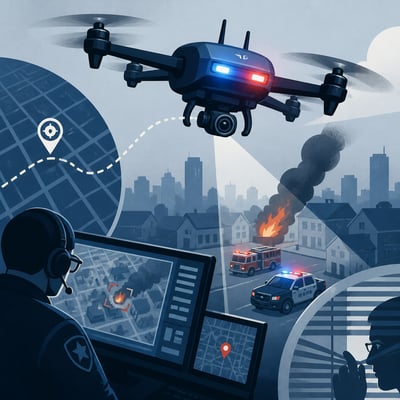
Police departments in Minnesota, Missouri, Illinois, and other U.
S. jurisdictions are testing or expanding drones that launch from stations or rooftop docks to assess 911 calls before officers, firefighters, or medical crews arrive. Agencies cite faster situational awareness, more efficient resource deployment, and the ability to resolve some calls without sending personnel, while costs, staffing, data retention, warrants, and mission creep remain unresolved. Minneapolis rejected a proposed Skydio pilot after public opposition, illustrating that adoption depends on local oversight and privacy safeguards as well as operational benefits.
The story broadens from a mostly Minnesota-centered debate to a wider multi-state rollout of docked first-responder drones, with new examples from New Jersey and more explicit emphasis on councils and regulators shaping adoption. The core tension remains the same, but current reporting puts greater weight on operational expansion alongside unresolved privacy and governance limits.
The story now centers more specifically on Midwestern police drone deployments and the emerging regulatory framework around them, rather than broadly on municipal first-responder drone adoption. Minneapolis’s rejected pilot and Minnesota’s reported warrantless-flight totals sharpen the privacy and accountability debate, while new reporting shows some programs are already clearing calls before officers arrive.
- Minnesota, Illinois, and Missouri agencies are actively using or evaluating first-responder drones.
- Drones sometimes clear calls without sending officers.
- Minnesota logged 9,080 warrantless police drone flights in 2025.
- Minneapolis rejected a 75-day Skydio pilot after public opposition.
- St. Charles County plans a $900,000 purchase of five systems.
The story has shifted from a broad account of drone-first-response pilots into evidence that the model is becoming a repeatable municipal operating system in several cities, with deeper integration into dispatch and emergency workflows. At the same time, the update adds clearer examples of oversight and operational constraints, showing both broader adoption and tighter accountability requirements.
- Programs are moving from trials into recurring operations.
- Some drones now carry rescue payloads such as flotation devices.
- Drone dispatch is integrating with gunshot detection systems.
- Oversight rules now include warrants and flight dashboards.
- Detroit faced an oversight failure.
The story has broadened from a set of city police drone pilots into a wider, more mature first-responder model now explicitly involving county agencies, sheriff departments, and public-safety regulators. The latest version also adds stronger evidence that drones are being used across more mission types, while privacy, vendor, and reliability disputes remain the main constraints.
The story has shifted from a general account of drone-first-responder growth to a more specific, operationally detailed picture of active deployments and planned scale-ups in several major U.S. jurisdictions. It also newly highlights a parallel backlash around surveillance, vendor choice, and local approval, especially in Minneapolis and West Hollywood.
- LAPD plans to expand its fleet from nine to 24 drones.
- Fairfax County plans to increase launch sites from 13 to 18.
- Some agencies report drones arrive first in 68% to 70% of missions.
- Minneapolis City Council rejected a 75-day police drone pilot.
- West Hollywood approved a pilot operated by the Los Angeles County Sheriff's Department.
The story has shifted from a broad roundup of pilot programs to evidence that drone-first-response is becoming operationally mature in some departments, especially Los Angeles, while new deployments in the Midwest and rescue uses broaden the use case. The debate is now less about whether the programs exist and more about scaling them with privacy and safety controls.
- LAPD has thousands of deployments and permanent program status.
- St. Charles County and O'Fallon are preparing new docked deployments.
- Ocean County uses drones for beach and missing-person rescue support.
- Station-based launchpads and rooftop docks are becoming the main operating model.
The story now places much more emphasis on policy controls and political resistance around drone-first-responder expansion, especially in Minneapolis and West Hollywood. It also adds clearer detail on how the programs are being operationalized through fixed docks, automated launches, and real-time video streaming.
The story has shifted from a general discussion of police drone-first-responder pilots to a more concrete deployment phase, with large programs now reporting mission data and measurable operational effects. It also broadened to include fire response and broader local-government adoption, while surfacing stronger evidence of privacy pushback and technical limits.
- Los Angeles, Fairfax County and Minnetonka report accumulated mission data.
- Nassau County is launching a $1 million, eight-site automated drone program.
- LAPD says about 10% of deployments canceled other responding units.
- Minneapolis rejected a no-cost Skydio pilot after a tied vote.
- Programs now cover fires, searches and vehicle incidents, not only tactical calls.
The story has narrowed from broad expansion of drone-first-responder programs to a more specific 2026 phase of city-level pilots and reviews focused on deployment logistics, vendor choice, and operating constraints. The emphasis has shifted from general rollout to whether these programs can scale safely and affordably under local weather, staffing, and privacy limits.
Police departments and some fire agencies are expanding drone-as-first-responder programs to reach 911 scenes before officers or firefighters arrive, stream live video, and sometimes reduce or redirect ground response. The material centers on operational rollout, vendor selection, and practical limits such as battery life, range, FAA approval, and crash risk. It also shows persistent concern about privacy, surveillance, and how these systems may be used beyond emergency response.