
 AI Governance
 Data Centers
 Drones
 Climate
 Privacy
 2026 Maine Senate
 Bob Dylan
Drones Expand Shark Beach Patrols
Coverage from The Conversation, DroneXL, and others
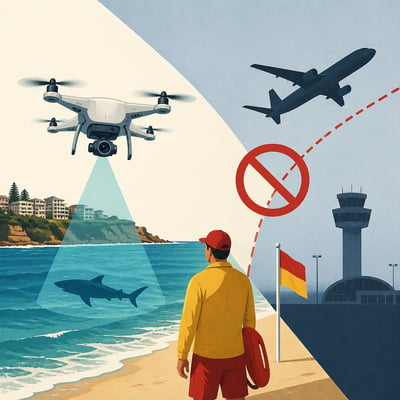
Police, parks agencies, and surf lifesaving organizations are expanding drone patrols to detect sharks, warn beachgoers, and support rescues.
New York programs are adding aircraft and operators, while New South Wales is extending surveillance to about 70 beaches and testing AI detection. The programs improve aerial visibility and can support faster warnings, but detection rates do not by themselves show that shark populations or bite risk are increasing, and evidence that drones reduce attacks remains limited.
The story now emphasizes concrete operational expansion and new stakeholders: New York and New South Wales are adding drones, coverage, and operators, while Queensland and aviation regulators enter the picture. It also sharpens the operational limit that drone detections can trigger closures and warnings, but still do not prove higher shark risk or reduced attacks.
The story has broadened from NSW and Long Island drone patrol expansion to a larger operational program that now includes New York City beaches and California research pilots. The new version also shows drones moving beyond observation into routine response workflows, public alerts, and AI-assisted analysis.
- NYPD drones now patrol several New York City beaches.
- UC Santa Barbara researchers are testing AI-assisted shark monitoring in California.
- Drones are being used for flotation-device delivery and rescue support.
- AI tools are being tested for shark counting and size estimation.
- Patrols now trigger public warnings and temporary swimming restrictions.
The story is largely unchanged, but it now adds clearer implementation details around NSW timing, Coogee airspace permissions, and new operational claims from Surf Life Saving NSW. The New York expansion remains the same in scale, while the overall framing shifts slightly toward swimmer rescue and closure decision-making.
The story has broadened from routine shark-spotting drone use and airspace limits into a larger operational evaluation of how far drone patrols can be scaled and what else they can do. The new version adds explicit limits on detection effectiveness, AI trials, and the possibility that more surveillance will increase precautionary closures and economic disruption.
- NSW plans daily drone flights at 70 beaches, including all 38 Sydney ocean beaches.
- Summer trials of AI shark detection and tagged-shark alerts are being added in Sydney Harbour.
- New York will expand Long Island coverage to 46 drones and 67 operators.
- Drones may also assist with distressed-swimmer and missing-person searches.
- More sightings may lead to additional precautionary beach closures and business impacts.
The story has broadened from a Coogee-specific drone exemption fight into a wider beach-safety rollout, with NSW moving to expand drone patrols statewide and New York joining as a parallel example. The core regulatory tension remains, but it is now tied to actual implementation rather than just a proposed rule change.
- NSW will expand drone patrols to 70 beaches year-round.
- New York is adding more drones and operators for shark scanning.
- Queensland trials are cited as outperforming some traditional shark-monitoring methods.
- Drone use is now framed as routine swimmer protection, not just emergency response.
A shark attack at Coogee Beach has pushed New South Wales to review drone restrictions that limit shark surveillance near Sydney Airport’s flight path. State officials and the Civil Aviation Safety Authority are considering exemptions or rule changes so lifesavers can use drones more freely for beach monitoring. The episode highlights a practical conflict between aviation safety rules and faster shark-detection tools.