
 AI Governance
 Data Centers
 Drones
 Climate
 Privacy
 2026 Maine Senate
 Bob Dylan

Iran’s Drones Spread Gulf War Risk
Coverage from Axios, The Washington Institute, and others
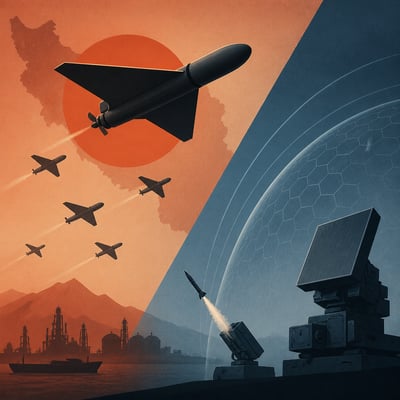
Iranian missiles and drones are being used alongside attacks on maritime traffic and U.S.-linked facilities across the Gulf and nearby Iraq, prompting U.S. strikes on Iranian military and drone infrastructure.
Gulf states and coalition forces have activated air defenses and intercepted repeated attacks, while incidents near the Strait of Hormuz have endangered commercial shipping and disrupted routes. The broader pattern points to sustained pressure on regional defenses, maritime security, and Iran’s ability to rebuild and expand its drone forces.
The story now includes concrete maritime casualties and evacuations, plus attacks affecting civilian infrastructure beyond military targets. It also shifts toward Iran’s longer-term effort to rebuild and expand a more diverse, hardened drone force.
The story now extends into September and gives greater prominence to maritime disruption and the operational challenge posed by inexpensive attack drones. New mine-laying claims and vessel damage sharpen the risks around the Strait of Hormuz, while casualty and damage reporting remains contested.
The story has been tightened and slightly broadened: the new version emphasizes attacks on maritime capabilities and commercial shipping disruptions, while also adding clearer evidence of injuries and infrastructure damage. It also reframes the diplomatic picture less as a collapsed deal and more as ongoing but still inconclusive de-escalation efforts.
The story now centers more explicitly on direct U.S.-Iran military exchange, with U.S. strikes on Iranian drone and air-defense infrastructure added to the conflict. It also broadens the maritime risk picture around the Strait of Hormuz and nearby Gulf facilities, while diplomacy is still described as ongoing but under strain.
- U.S. strikes targeted Iranian drone storage, launch, surveillance, air-defense, and maritime sites.
- Qatar reported injuries from falling shrapnel during interceptions.
- Iranian attacks were reported against the UAE, Qatar, Kuwait, Bahrain, and Oman.
- An interim U.S.-Iran deal reportedly collapsed.
- Commercial vessels near Oman were damaged, heightening Strait of Hormuz risk.
The story has broadened from a Strait of Hormuz shipping disruption into a wider, multi-front drone campaign spanning Iraq, Saudi Arabia, Jordan, the Red Sea, and even Egypt’s Damietta port. The new reporting also adds clearer evidence of persistent proxy activity, retaliatory strikes, and unresolved attribution across several incidents.
- Egypt confirmed a drone caused fires on two gas vessels at Damietta.
- Saudi oil infrastructure was reportedly damaged at Abqaiq and Jazan.
- Drone attacks continued during temporary pauses in direct U.S.-Iran strikes.
- U.S. and Saudi forces retaliated against alleged militia sites in eastern Iraq.
- Disputed attribution now covers Damietta, Houthi claims, and Iraq-based militia attacks.
The story now emphasizes that the Strait of Hormuz disruption is being driven not just by attacks on military and shipping targets, but also by contested attribution and damage assessments that leave the true scale of the threat less certain. It also broadens the proxy-risk frame, highlighting Houthi and Hezbollah pressure across the Red Sea and Levant.
The story has broadened from a Hormuz-focused drone conflict into a wider regional threat to shipping, bases, and supply chains. The biggest new element is the reported sharp drop in Strait of Hormuz traffic, alongside evidence that Iranian-linked activity and transfers may extend the risk to the Red Sea and Levant.
- Strait of Hormuz traffic reportedly fell to 14 daily transits from over 130 before the war.
- U.S. strikes expanded to coastal surveillance, missile, and maritime facilities.
- Reported attacks reached Bahrain, Kuwait, Jordan, and Iraq.
- A U.S. soldier died during unexploded ordnance detonation at Erbil.
- IRGC reportedly moved fiber-optic FPV drones to Hezbollah via Iraq and Syria.
The story is largely stable, but the framing has sharpened around the Strait of Hormuz as the central flashpoint and around a specific contested claim that Iran downed a U.S. MQ-9 Reaper. The current version also more explicitly emphasizes U.S. strikes on Iranian drone-related infrastructure and the cost-exchange problem in drone defense.
The story has shifted from a mostly capability-focused account of Iran's drone resilience to an active Gulf conflict narrative, with repeated interceptions, retaliatory strikes, and shipping disruptions now front and center. Iran's production-recovery theme remains, but it is now framed within a live strike-and-intercept cycle rather than mainly as a sanctions-and-rebuild story.
- Repeated U.S. and partner interceptions of Iranian drones and missiles.
- Retaliatory strikes on Iranian surveillance, air-defense, and drone-storage sites.
- Attacks on tankers and convoy rerouting near Oman.
- A sustained campaign using dispersed launches and smaller repeated waves.
- Layered counter-drone defense combining shipborne weapons and air defenses.
The story shifts from a general account of Iran’s drone resilience to a more specific emphasis on how production is recovering through dispersed, hardened manufacturing, while external support from Russia and China appears to sustain the ecosystem. The counter-drone response is also broadened from interception to intelligence, sanctions, cyber, and export-control measures.
- Dispersed manufacturing, underground facilities, and small workshops speed production recovery.
- Russia and China are described as sustaining Iran’s drone ecosystem.
- U.S. officials say Iranian drones now include improved sensors and electronic-warfare features.
- Counter-drone efforts now include sanctions, intelligence, cyber, customs, and export controls.
Iran’s one-way attack drone program remains a central element of its precision-strike and coercive warfare toolkit, even after heavy damage to arsenals, production lines, and launch infrastructure. The material emphasizes how Tehran adapted from large early-war salvos to smaller, dispersed, and more selective attacks that continue to strain air defenses and threaten shipping, bases, and critical infrastructure. A parallel theme is the U.S. effort to counter low-cost drones with layered defenses and cheaper offensive systems that can shift the cost balance.