
 AI Governance
 Data Centers
 Drones
 Climate
 Privacy
 2026 Maine Senate
 Bob Dylan

Europe Scales Counter-Drone Defenses
Coverage from Dronexl, Euronews, and others
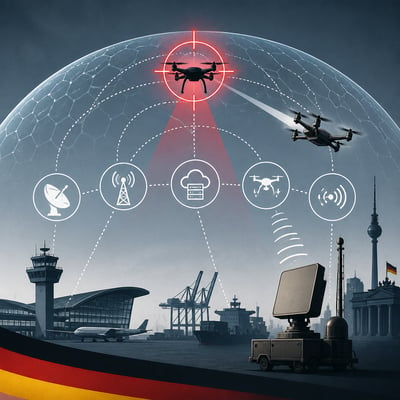
European defense companies and industrial partners are expanding counter-drone capabilities, combining radar and multisensor detection with jamming, lasers, nets, and autonomous or human-supervised interceptors.
Germany is a major focal point, driven by reported drone activity around airports and critical infrastructure, while Ukraine’s battlefield experience is shaping demand for lower-cost defenses against small and mass-produced threats. The central challenge is turning prototypes and announced partnerships into affordable systems that can be manufactured at scale and legally deployed in civilian and military airspace.
The story now emphasizes Germany’s sharper operational focus, tying counter-drone demand more directly to airport, port, and critical-infrastructure incursions while stressing civilian-airspace legal constraints. It also reframes the market around getting prototypes and partnerships into affordable, scalable deployment rather than just developing the technology.
The story has shifted from a general move toward production and deployments to a more specific picture of layered counter-drone defense: German firms are now pairing detection, jamming, capture, and kinetic defeat, while Germany has also tightened the state’s interception authority. The most notable new elements are the focus on mass-attack defenses and concrete industrial scaling plans.