
 AI Governance
 Data Centers
 Drones
 Climate
 Privacy
 2026 Maine Senate
 Bob Dylan
Drone Industry Shifts Toward Dual Use
Coverage from Drone Industry Insights, Commercial UAV News, and others
Going On
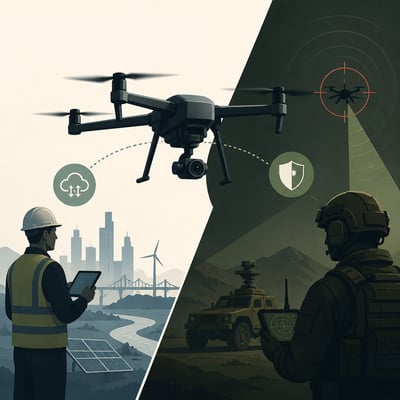
Drone Industry Insights counts 1,413 companies across 70 countries, up from 1,076 in its 2022 map.
The story now has a sharper industrial scale and policy-constrained framing: the drone market is not just growing around services and dual-use demand, but is now mapped at 1,413 companies across 70 countries with defense procurement standards increasingly shaping commercial operations. The main new tension is that scaling is being held back by BVLOS delays, compliance costs, and supply-chain or market-access constraints.
The story is now framed more explicitly as a civil drone market reallocation toward services and compliance-heavy business lines, with dual-use demand and regulation emerging as the main forces shaping where value accrues. The current version also adds more concrete market structure, including the dominance of services and the fragmentation/churn dynamic.
The story now emphasizes a much larger, more fragmented global drone industry, with hard data on company count, turnover, and regional spread replacing the earlier broader market-shift framing. It also sharpens the policy angle around U.S. onshoring, Blue UAS/NDAA compliance, and autonomy infrastructure as the main forces shaping commercialization.
- 1,413 companies operate across 70 countries in the global drone industry.
- Industry turnover includes mergers, acquisitions, bankruptcies, and pivots.
- U.S. onshoring pressure is linked to Blue UAS and NDAA alignment.
- Autonomous operations depend on base stations and charging infrastructure.
- Dual-use demand is increasingly shaped by Ukraine-related battlefield lessons.
The drone sector is shifting toward service-led and dual-use business models, with drone-as-a-service, systems integration, and regulatory support becoming more central to market structure. Industry forecasts show continued civil market growth, while defense demand and counter-drone needs are reshaping investment, company positioning, and product categories. The topic is coherent around commercialization, but it spans market mapping, forecasts, and company-level expansion signals.