
 AI Governance
 Data Centers
 Drones
 Climate
 Privacy
 2026 Maine Senate
 Bob Dylan
Communications-Resilient Autonomous Military Drones
Coverage from DroneXL, Tom's Hardware, and others
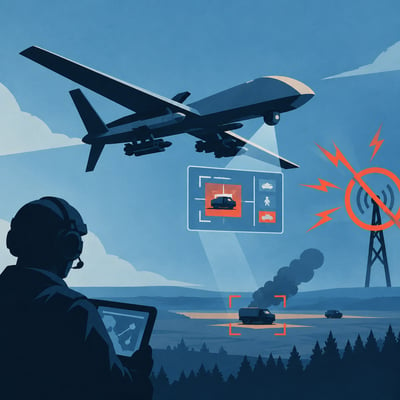
Swedish defense demonstrations show military drones using onboard AI to identify, prioritize, and engage targets while continuing local inference through communications disruption; procurement and human-control arrangements remain unsettled.
If you read one thing
It offers the clearest overall account of autonomous targeting, communications-resilient operation, and the resulting accountability gap.
The evidence
It adds concrete technical performance figures and evidence that the system operated autonomously despite network loss.
Best explainer
It explains how federated edge AI supports autonomous drone operation and model updates in disrupted communications environments.
Autonomous target selection and engagement is demonstrated
Scaleout’s ALMA system detected, ranked, selected, and engaged an armored vehicle without a human selecting the specific target or issuing continuous commands. The demonstrations establish perception-to-attack execution as a tested capability, though not yet a deployed one.
Edge autonomy is designed for communications-denied conditions
The system’s onboard AI continued inference, logged detections, and conducted active learning after communications were lost, then synchronized after reconnection. Link-loss resilience and decentralized model operation are central features for jamming-contested environments.
Human-control and accountability requirements remain unresolved
The demonstrations leave open where operator veto or abort authority exists after a drone loses communications and who is responsible when autonomous targeting is wrong. Existing policy statements and human-oversight expectations do not resolve this specific lost-link accountability gap.
approximately 200 seconds
reconnaissance duration
“The system spent approximately 200 seconds conducting reconnaissance and completed the full mission in under 320 seconds without requiring communications, supporting Scaleout’s claim that it can operate in environments affected by electronic warfare.”
under 320 seconds
full mission duration
“The system spent approximately 200 seconds conducting reconnaissance and completed the full mission in under 320 seconds without requiring communications, supporting Scaleout’s claim that it can operate in environments affected by electronic warfare.”
-18 degrees Celsius
operating temperature
“In a separate February demonstration at BTC Karlskoga in Sweden, an Airolit S1 airframe operated in snow and temperatures of -18 degrees Celsius. It ran the YOLOv8 Nano object-detection model on Nvidia’s Jetson Orin Nano. Scaleout reported approximately 30 frames per second at around 20 meters per second, with target latency of 30 milliseconds or less.”
around 20 meters per second
airframe speed
“In a separate February demonstration at BTC Karlskoga in Sweden, an Airolit S1 airframe operated in snow and temperatures of -18 degrees Celsius. It ran the YOLOv8 Nano object-detection model on Nvidia’s Jetson Orin Nano. Scaleout reported approximately 30 frames per second at around 20 meters per second, with target latency of 30 milliseconds or less.”
30 milliseconds or less
target latency
“In a separate February demonstration at BTC Karlskoga in Sweden, an Airolit S1 airframe operated in snow and temperatures of -18 degrees Celsius. It ran the YOLOv8 Nano object-detection model on Nvidia’s Jetson Orin Nano. Scaleout reported approximately 30 frames per second at around 20 meters per second, with target latency of 30 milliseconds or less.”
No new member articles were supplied, and there is no prior state from which to establish a material real-world change.