
 AI Governance
 Data Centers
 Drones
 Climate
 Privacy
 2026 Maine Senate
 Bob Dylan

Amazon Prime Air Expansion Pressures
Coverage from UAV Coach, The Reader, and others
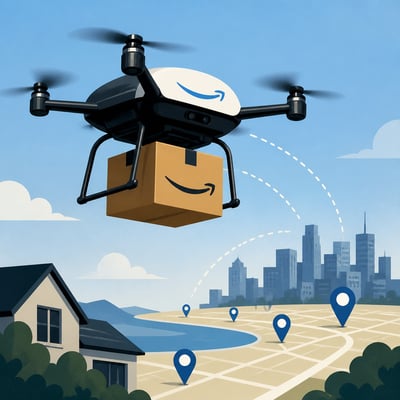
Amazon Prime Air is moving from limited pilots to live package delivery across several U.S. markets and Darlington, UK.
The rollout uses approved beyond-visual-line-of-sight operations and sensor-guided aircraft, but remains bounded by short service radii, payload and weather limits, community noise and privacy complaints, local planning questions, and isolated safety incidents.
If you read one thing
It provides the clearest broad view of Prime Air's suburban rollout, operating limits, and community tradeoffs.
The evidence
It explains the FAA-approved safety and airspace framework supporting scaled Metro Detroit operations.
The counter-case
It supplies a concrete delivery failure that challenges claims that autonomous safeguards are already reliably scalable.
The evidence
It documents how flight frequency, noise modeling, wildlife concerns, and limited local control constrain expansion in practice.
Geographic rollout is advancing unevenly
Prime Air is operating recurring commercial deliveries across multiple U.S. markets and Darlington, with Papillion recording about 6,000 flights in two months and Metro Detroit exceeding 100 deliveries a day at one hub. Expansion remains organized around localized fulfillment-center hubs rather than a demonstrated nationwide network.
The service remains tightly bounded
Prime Air remains specialized for packages of roughly five pounds or less within about 7.5 miles of a fulfillment site. Daylight, severe weather, airspace restrictions, wildlife buffers, and suitable drop conditions continue to determine when and where flights can operate.
Operational reliability remains under scrutiny
Autonomous navigation and obstacle-avoidance systems support active delivery, but the Darlington crash, unintended or failed package drops, and reported Richardson GPS-related problems show that safety and delivery accuracy remain unsettled. Investigations and incident reporting continue to make reliability a mixed constraint on further scale.
Community acceptance and local permissions constrain scale
Noise, frequent low-altitude overflights, privacy concerns, and wildlife protections are generating friction across Nebraska, Michigan, Texas, and Louisiana as flight volumes become routine. Federal control over routing limits U.S. municipal authority, while local planning, public comment, and acceptance requirements continue to complicate wider deployment.
200 feet
cruising altitude used in FAA noise comparison
“The report found that the drone produces substantially less noise while cruising overhead at 200 feet than during a delivery.”
10 drones
maximum drones simultaneously airborne at the Baton Rouge site
“Amazon has said that 20 drones are based at the Baton Rouge site and as many as 10 can be in the air at once.”
two to five minutes
interval between drone passes over residents
“Residents of Baton Rouge's Broadmoor subdivision told WAFB they see a drone roughly every two to five minutes.”
1,000 packages per day
requested daily delivery capacity
“The Federal Aviation Administration approved Amazon’s local operations after the company applied to deliver as many as 1,000 packages per day in several metropolitan areas.”
7.5-mile miles
operating radius from warehouse
“The Papillion flights operate within a 7.5-mile radius of the warehouse and cover parts of Papillion, La Vista, Millard and Gretna.”
Contested Issue
Do Prime Air's autonomous safety systems provide a sufficiently reliable basis for scaled drone delivery?
Regulatory and company-backed evidence points to detect-and-avoid systems, obstacle scanning, extensive testing, and BVLOS approvals as a safety basis for autonomous delivery, while reported crashes and delivery failures indicate that real-world reliability remains unproven for broad expansion.
Authorized safety controls
FAA- and CAA-authorized mitigations, detect-and-avoid capabilities, obstacle scanning, weather screening, and extensive testing are considered capable of supporting safe autonomous BVLOS delivery.
Unproven operational reliability
Crashes, unintended package drops, and other reported delivery failures indicate that existing safeguards have not yet demonstrated consistently reliable performance for broad real-world scaling.
The new Baton Rouge report reinforces existing concerns about frequent Prime Air overflights and delivery noise but does not materially change the topic’s established picture.
Previously
Amazon Prime Air is moving from limited pilots to live package delivery across several U.S. markets and Darlington, UK. The rollout uses approved beyond-visual-line-of-sight operations and sensor-guided aircraft, but remains bounded by short service radii, payload and weather limits, community noise and privacy complaints, local planning questions, and isolated safety incidents.
Prime Air is now characterized as an operating commercial service, not merely a collection of pilots, with substantial flight activity and customer demand in Omaha and Metro Detroit. That operational progress is accompanied by newly documented GPS-related and investigated safety incidents, reinforcing that scaling remains conditional.
The story now explicitly includes collisions and failed package drops, strengthening the focus on delivery reliability alongside existing safety, approval, and community concerns.
 About Amazon / Charles Clark