
 AI Governance
 Data Centers
 Drones
 Climate
 Privacy
 Bob Dylan

Autonomous Drones Expand Maritime Weather Missions
Coverage from FedScoop, DRONELIFE, and others
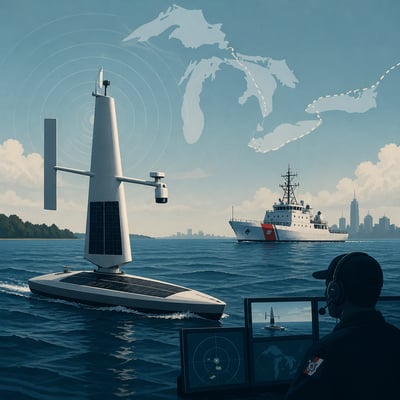
U.S. government agencies and research partners are deploying autonomous surface and aerial drones to extend maritime surveillance and improve weather observations.
The Coast Guard is using Saildrone Voyager vessels on the Great Lakes and in the Northeast for persistent monitoring, while NOAA and academic researchers are using drones and unmanned surface vessels to collect data around hurricanes and in the lower atmosphere. These missions show drones moving beyond short flights toward long-duration, remotely supervised operations, while questions remain about data governance, autonomy, and the reliability of preliminary forecasting benefits.
The story now gives a clearer implementation picture: Coast Guard surveillance has expanded to the Northeast, and NOAA’s aerial and surface drone missions are more concretely tied to hurricane-season operations. The main framing shift is from general monitoring experiments to longer-duration deployments with still-unsettled data-governance and autonomy limits.
The story broadens from Coast Guard and NOAA drone trials into a larger operational weather-observation system, adding Oklahoma’s 3D Mesonet and Meteomatics infrastructure. The new emphasis is on repeated sensing, forecast-model integration, and the buildout of supporting launch and recovery hardware, while privacy and contractor accountability remain unsettled.
- Oklahoma 3D Mesonet adds repeated vertical atmospheric profiles.
- Observations extend to roughly 20,000 feet.
- NOAA data are entering forecast-model and rapid-intensification research.
- Meteobase infrastructure supports automated drone operations.
- Contractor data retention and access remain unclear.
The story has broadened from Coast Guard and NOAA drone testing into more explicit 2026 operational plans, with NOAA now committing to a specific hurricane-season deployment of Saildrone Explorers and Black Swift aerial drones. The framing also shifts toward unresolved governance and effectiveness questions, not just adoption of unmanned systems.
The story has shifted from a general account of autonomous maritime surveillance to a clearer operational expansion: the Coast Guard is scaling Saildrone deployments beyond the Great Lakes into the Northeast, while NOAA’s drone work is moving closer to routine hurricane-forecasting use.
The story broadened from a Coast Guard-focused Great Lakes surveillance rollout to a wider U.S. government operational program that now includes NOAA using autonomous surface vehicles for hurricane and ocean research. The added missions and geography make the deployment look more established and multi-agency, while human oversight remains unchanged.
The story is largely stable, but the latest version tightens the framing around a routine Coast Guard rollout and slightly narrows the mission language to surveillance, border monitoring, and weather support. It also more explicitly identifies Saildrone as the vendor behind the Voyager platforms.
The story shifts from an expansion in autonomous sail-drone surveillance to confirmation that the Coast Guard is now actively deploying the systems in service on a seasonal basis. The emphasis is more operational and concrete, with added clarity on human oversight and manual control.
The story is reframed from a general rollout of autonomous sail drones into a more operationally specific Coast Guard surveillance mission, with added emphasis on persistent border monitoring and collision-avoidance AI. The current version also makes the deployment sound more routine and integrated into ongoing Great Lakes coverage.
The story has shifted from a broadly described expansion of Coast Guard autonomous sail drone operations to a more concrete operational rollout on the Great Lakes. The current version also narrows the mission emphasis to surveillance, cross-border traffic monitoring, and weather/safety data.
The story now frames the Coast Guard effort as an expansion from a seasonal Great Lakes deployment toward a broader operational footprint, rather than just a discrete pilot. It also adds emergency-response support as a more explicit mission area alongside surveillance and weather collection.
The story has shifted from a general expansion of Coast Guard autonomous surveillance to a more concrete, operational deployment with clearer evidence of contract-backed scaling. The strongest new signal is that the Great Lakes mission is now framed around specific seasonal operations, continuous oversight, and a larger potential fleet size.
The U.S. Coast Guard is expanding use of autonomous Saildrone vessels on the Great Lakes to improve maritime domain awareness, border monitoring, and detection of suspicious activity. The systems combine wind-and-solar power with radar, cameras, AIS receivers, and AI-assisted collision avoidance, with human operators continuously overseeing the craft and stepping in when needed. The deployment reflects a broader shift toward persistent unmanned surveillance to support limited crewed patrol resources across large, busy waterways.